
The Lamb Becomes a Scarce Asset: The Decline of the British Sheep Flock Forces a Redesign of the Food Chain
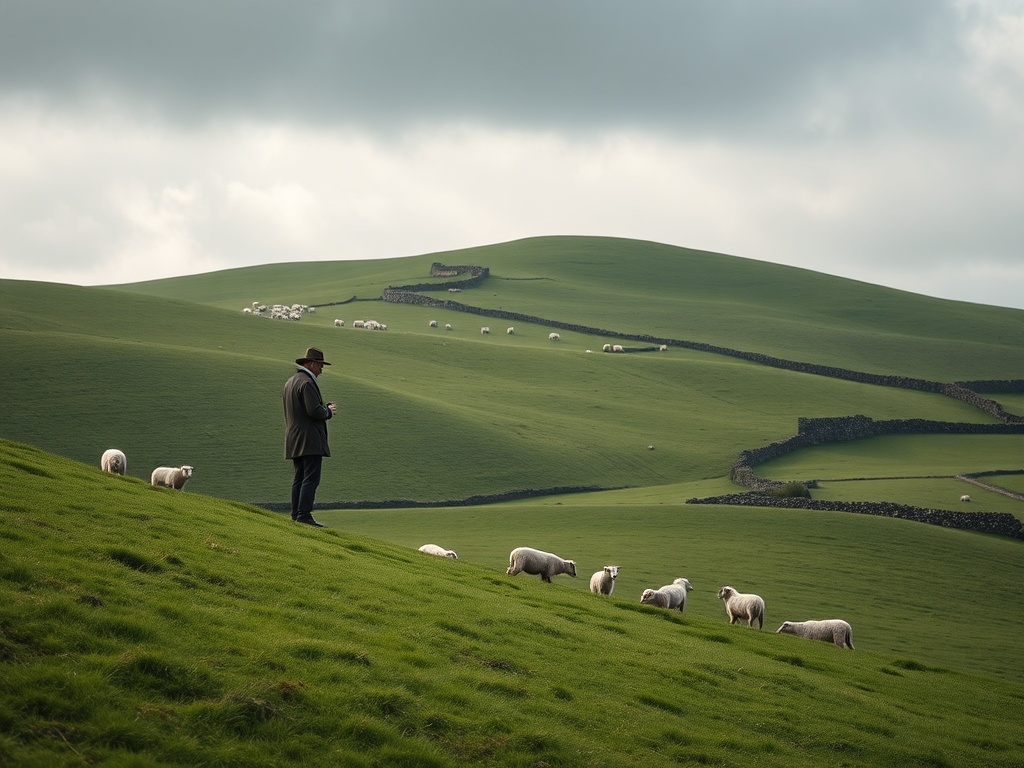
In the United Kingdom, lamb has been a culturally staple product for decades, supported by a geography of hills, pastures, and a rural economy that functioned as "living infrastructure." However, this infrastructure is shrinking.
The numbers leave no room for benign interpretations. As of June 1, 2025, the total sheep flock in the UK has fallen to 30.5 million, marking a year-on-year decline of 1.7%. In England, the signal is harsher: 13.3 million, a 3.8% drop in a year, equivalent to around 520,000 fewer sheep. The breeding flock in England dropped to 6.43 million, its lowest level in fifteen years. In tandem, lambs—almost half of the total stock—decreased to 14.8 million in the UK, reflecting a 2.9% year-on-year decline.
This story is not just about livestock; it reveals the productive capacity of a nation and how it reorganizes its food chain when domestic supply contracts. In sustainability debates, narratives often drift into abstract values. Here, sustainability is arithmetic: fewer breeding ewes today means fewer lambs tomorrow, and fewer lambs tomorrow translates into higher prices, increased imports, and political tension.
The Decline of the Flock Is Not an Accident, It’s a Signal of Incentives
The immediate explanation for the 2025 decline uncovers a troubling pattern: the market can destroy its own productive base when short-term incentives are too strong. The AHDB attributes much of the decline to a rational decision by producers: not retaining replacements because the cull sheep trade has been particularly strong. By early July 2025, the average price of cull ewes in England and Wales hovered around £129 per head, above the levels of the previous year. When culling pays off, next year’s “factory” is sold piece by piece.
The mechanical consequence is straightforward. A smaller breeding flock limits the next harvest of lambs. Projections for 2025 production have already been revised downwards to 274,000 tons. And the industry message is clear: the decline in the breeding flock signals a smaller lamb harvest in 2026.
In Scotland, the decline moderated: the agricultural advisory service highlighted that the 2025 breeding flock experienced its smallest drop since 2021, with 101,889 fewer sheep than in 2024. However, this partial stabilization does not reverse the trajectory: it reduces the speed of contraction, not its direction.
What is critical for a realistic sustainability analysis is understanding that livestock farming does not respond to editorials; it responds to margins. If the system rewards liquidating young females today, it is programming future scarcity. Moreover, this scarcity is not distributed equitably: it first impacts consumers, but it also affects the rural economy that relies on the complete cycle.
The Network and Circularity: When Farming Transitions from "Reserve" to "Critical Node"
I view this phenomenon through a singular lens: The Network and Circularity. Not as a slogan, but as an economic engineering diagnosis. The British sheep chain is not a line; it’s a network of interdependent nodes: breeding farms, finishing systems, abattoirs, chilled logistics, export and import channels, retail, restaurants. When the "breeding flock" node diminishes, it doesn’t simply break one section; it deforms the entire network.
The historical mistake of many modern food systems has been treating them as if they were infinitely replaceable, as though supply were an “input” that appears when the market demands it. Extensive farming operates fundamentally differently: it is biology with timelines, and biology does not accelerate because the price committee demands it.
In this framework, sustainability shifts from a moral debate to biological capital management. The breeding female is a productive asset. Selling her for the short-term incentive of culling equates to decapitalizing future capacity. In financial industries, this would be recognized as a reduction of installed capacity; in food, it’s often dressed up as “cycle.”
Moreover, the network has a territorial component. In hilly and marginal areas, sheep do more than produce meat: they sustain activities, jobs, veterinary services, local transport, and a continuity of land use. When the critical mass of livestock diminishes, the local economy loses density, and the network becomes more expensive to operate per unit produced. Corporate sustainability, for supermarkets and brands, is less about publishing commitments and more about ensuring that the supply chain remains operable at reasonable costs.
Fewer Sheep, More Volatility: The New Hidden Cost of “Food Security”
When a country reduces its domestic supply of protein, the conversation shifts to imports, consumer substitution, and elasticities. However, the structural point is different: with less stock, the system gains volatility.
With a declining British sheep flock standing at 30.5 million, any shock amplifies. In a system with more slack, a production dip can be absorbed by biological inventory and retention decisions. In a compressed system, the margin for maneuver shrinks. Data already show pressure at the base: the “other sheep and lambs” component fell 2.7% to 15.7 million, and the key indicator—lambs under one year—dropped despite temporary distortions from carryover of “older” lambs from 2024.
Here lies an implication for business leadership that is often underestimated: the sustainability of supply cannot be secured solely through contracts; it requires redundant capacity and price signals that do not destroy the future. If the culling price drives the liquidation of replacements, the market is essentially paying to reduce its resilience.
Volatility also reorganizes the menu. The original headline suggests it: sheep are disappearing from the hills and plates. In terms of consumption, this does not mean immediate hunger; it signifies a shift in pattern. Lamb becomes a protein with greater intermittency or higher relative price. In chain terms, it imposes tension on those who built their value proposition on stable availability.
And the impact is not limited to sheep. The June 2025 census also reflects a broader livestock contraction: in England, the cattle herd fell to 4.91 million (-1.4% year-on-year), the lowest level on record. In the UK, the cattle stock dropped to 9.29 million (-1%), with a marked decline in beef cows. Fewer animals across two chains simultaneously signals an era: local protein expansion becomes more challenging when costs, policies, and margins push in the opposite direction.
The Inevitable Redesign: From Producing More to Producing with System Architecture
The political temptation upon hearing this story is straightforward: request "more production" or blame a specific actor. Such a response is insufficient. The real change is that the UK is approaching a regime wherein ruminant protein requires a system architecture to sustain itself.
In the immediate term, the clock is ticking toward 2026: fewer breeding females today means fewer lambs in the next cycle. The AHDB emphasizes the importance of monitoring conditions and intentions leading up to the breeding season; that period defines the trajectory of the next harvest. This is not merely a technical detail; it's the national supply dashboard.
In the medium term, this redesign has four concrete implications for corporate leaders and public decision-makers:
1. Price signals that do not decapitalize. If the market pays too much for culling relative to retention, it incentivizes a liquidation that jeopardizes future supply. Mechanisms to soften that cycle are not charity: they are systemic risk management.
2. Long-term contracts and relationships. Retailers purchasing on the spot in a shrinking system assume that the network will always be there. That assumption expires when stock declines, and the supply becomes more competitive.
3. Efficiency without romanticization. The problem cannot be solved with rural nostalgia or marketing campaigns. It requires productivity per hectare compatible with environmental limits and the producer’s economy.
4. Replacement planning. If local supply falls, the food system reorganizes: more imports or increased consumption of other proteins. This transition impacts footprints, trade balances, and consumer perceptions. Ignoring it allows adjustments to occur via shocks.
The disappearance of sheep from the British hills is an overly comfortable metaphor. The reality is more operational: the country is witnessing the reduction of its biological capital and how its food network is losing maneuverability. Global leaders and decision-makers who understand that supply is a network, and that the network is managed as critical infrastructure, will be the only ones capable of maintaining competitiveness, price stability, and social legitimacy in the new protein landscape.