
Faraday Future Bets on Robots for Its Survival
There are buildings that stand tall because someone injects new cement into them each quarter. Faraday Future has been one of those for years. Its latest annual results report, released on March 31, 2026, offers something unusual: not just numbers, but evidence that the company is trying to change the central load-bearing beam of its structure before it collapses. The question I pose as a business model analyst is not whether robots are a good product. It's whether 22 units delivered can support the weight of a company that burned through $107.5 million in operational cash during 2025.
The answer is not simple, but the blueprints are readable.
The Pivot No One Calls a Pivot
Faraday Future was born as a bet on the ultra-premium electric vehicle. Its flagship model, the FF 91, began deliveries in 2023 with a price tag placing it in the stratosphere of the market. The architectural problem of that model was evident from the outset: sky-high fixed costs, a microscopic customer base, and a production chain that relied on constant external financing to breathe. This is not a moral critique; it's a mechanical description.
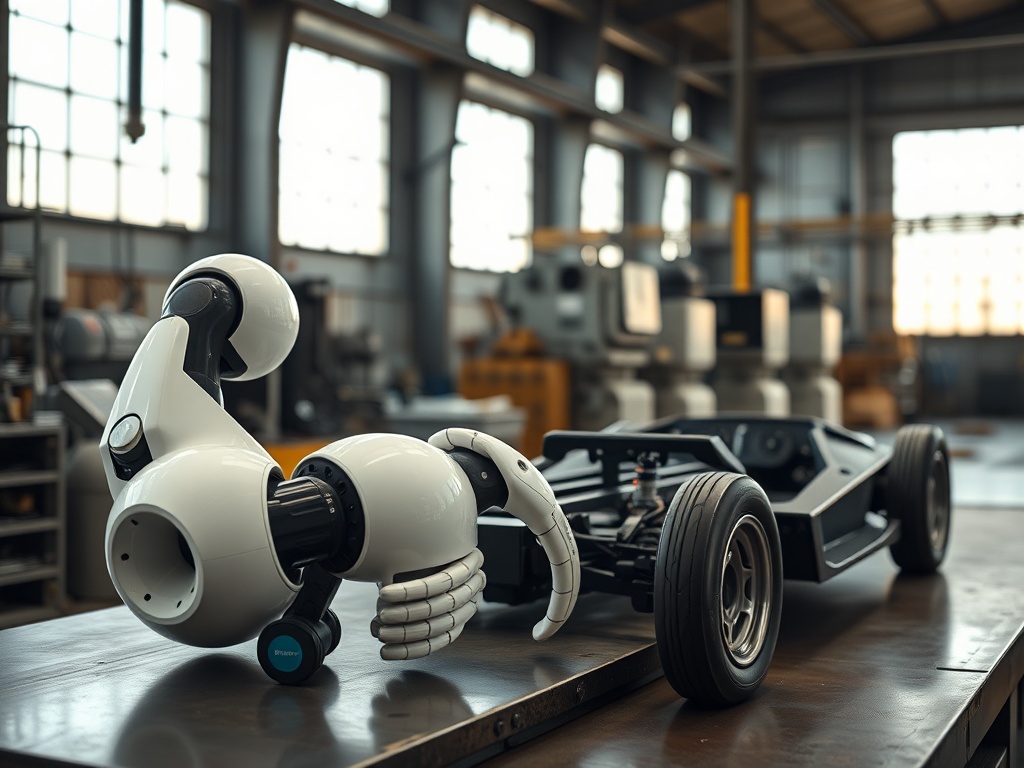
The 2025 report confirms that the company recognized this load-bearing failure. During the fourth quarter, it registered the first pre-production vehicle of its FX Super One model at its plant in Hanford, California, and formalized the launch of three lines of AI-integrated robots under the Futurist, Master, and Aegis series. More importantly, by the end of the first quarter of 2026, it reported 22 robot units delivered with positive gross margin. The company exceeded its own goal of 20 units in the first month of deliveries.
This is no small achievement in terms of signal. It is the first time that Faraday Future can showcase a product with positive gross margin since its inception. The crucial detail for structural analysis is as follows: robots require significantly less capital investment than an electric vehicle. This changes the fixed versus variable cost equation in a non-trivial way. While a luxury EV needs a factory, federal approvals, a complex supply chain, and months of sales cycles, an educational or home security robot can be sold through digital channels, distributors, and even dealerships with a substantially leaner capital structure.
The architecture they are trying to build makes sense on paper. The problem is that paper and concrete are different materials.
When Numbers Reveal Structural Stress
The consolidated balance sheet as of December 31, 2025, shows a positive net worth of $7.7 million, recovered following a debt optimization of approximately $100 million. In absolute terms, it's a figure that fits within the marketing budget of a medium-sized company. The company cancelled about $44.6 million in outstanding warrants to reduce future dilution and generated $161.4 million in financing inflows throughout the year, double that of 2024.
However, the operational loss for the full year was $331 million, or $185 million excluding one-time asset impairments associated with the transition from the FF 91 program to the FF 92, and the reconfiguration for the Super One. Net operational cash was negative at $107.5 million. In March 2026, Nasdaq notified the company of its failure to meet the minimum listing price of one dollar per share, with 180 days to regain compliance.
This is the map of stresses that a business model engineer must read precisely: the company is financing its transformation with convertible debt and equity that generates dilution while attempting to demonstrate that a new product line with positive gross margin but microscopic volume can become the cash engine that gives it time to scale its vehicle business. The declared objective is to reach over 1,000 accumulated robot units by the end of December 2026. This implies multiplying the current volume by more than 45 times in less than nine months.
It's not impossible. But no engineer signs off on a blueprint with that slope without identifying critical failure points.
The Segmentation That Determines If the Model Works
What interests me most in analyzing Faraday Future's robot proposal is not the technology itself but the specificity of the segment. The company announced three primary uses: education, home security, and entertainment. This is, structurally, a reasonable segmentation. Three segments with differing willingness to pay, distinct sales cycles, and channels that do not require the same certifications as a street vehicle.
The detail that reinforces the mechanical viability is the distribution channel they are activating. After their presence at the NADA Dealer Summit, the company signed memorandums of understanding with car dealerships to sell both the Super One and the robots under the same commercial umbrella. This is architecturally smart: it reuses an already established distribution network for a product with less regulatory friction and shorter sales cycle. It’s not genius; it’s efficient channel engineering.
The variable that remains unresolved in this blueprint is the dependence on manufacturing. The company acknowledges in its own prospectus that it relies on a single OEM manufacturer for the robots, with a supply chain exposed to tariff uncertainties and possible reviews by the U.S. Department of Commerce for products with components manufactured in China. That is the screw that could loosen the structure if the regulatory or trade environment changes. This is not speculation: it is explicitly listed among the risk factors in the report.
What Faraday Future has done, in terms of business model, is identify that its problem was not with the product but with the fit among proposal, segment, and channel. The ultra-premium EV was a proposal for a market segment that was too narrow, through a channel that required capital investment that the company could not sustain independently. Robots represent a more modular proposal, for broader segments, with channels that generate faster turnover. While this does not guarantee success, it does change the direction of structural stress.
The Difference Between a Blueprint That Survives and One That Collapses in Execution
The cycle that Faraday Future describes for its robots, where scale generates data, the data improves system intelligence, and that improvement accelerates sales, has theoretical coherence. The issue with models that depend on this type of feedback is that they require critical mass before the cycle becomes self-sustaining. With 22 units delivered, the company is in the most expensive phase of the cycle: the one that requires investment without proportional returns yet.
The company declared software revenue as a goal before the end of 2026. This is relevant because software has fundamentally different cost structures from physical robots: near-zero marginal costs once developed, scalable without proportional capex. If they achieve this conversion, the model's architecture begins to exhibit different properties. If not, the model remains a hardware business with all its associated costs.
The net worth of $7.7 million is the most honest indicator of the current state of the building. It is positive, which is a real improvement over previous periods. However, it is structurally thin to absorb the shocks of a company burning over $100 million per year in operations, and that faces homologation, large-scale production, and delivery of a vehicle in such a competitive and regulated market as the U.S.
Companies do not fail because they lack product vision or because their engineers are mediocre. They fail when the pieces of the model—the target segment, the channel they use to reach it, the cost structure that supports operations, and the capital that finances the cycle—fail to fit into a sequence that generates cash before the cement runs out. Faraday Future has changed several of these pieces simultaneously. The 2026 report will reveal whether the new blueprint can withstand the load.