
The Moment a Mayor Stops Managing and Starts Leading
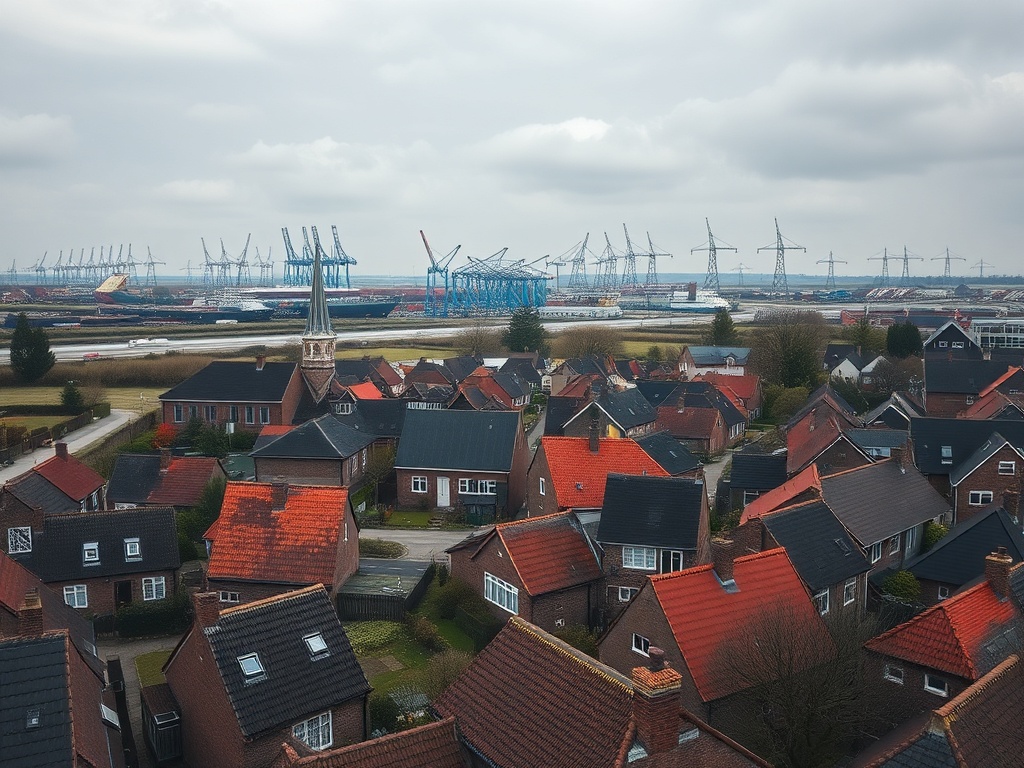
In November 2025, the municipal council of Moerdijk, a village of 1,100 residents in North Brabant, Netherlands, voted for its own extinction. This was not a metaphor; it was a formal resolution: the village will be demolished to free up 450 hectares for the Powerport, a hub for energy infrastructure that includes high-voltage substations (380 kV), hydrogen plants, and pipelines to transport ammonia and hydrogen from the port of Rotterdam to Limburg.
Mayor Aart-Jan Moerkerke described the decision as "emotionally challenging" and warned that they were asking for "a tremendous sacrifice" from their neighbors. Construction is set to begin in 2028, with completion projected by 2033. Residents may remain until a decade after approval. The slogan that emerged from the public assembly was brutally honest: Moerdijk moet weg - Moerdijk must go.
Before turning this into a debate about energy or urban planning, pause. What happened in that room was not a technical decision. It marked the exact moment when a leader stopped seeking a comfortable exit and chose to bear the weight of what was right over what was popular. This gesture deserves to be dissected with surgical precision, as it exemplifies what most organizations avoid with remarkable efficiency.
The Architecture of a Decision No One Wanted to Make
The first thing this case reveals is the anatomy of a bottleneck, which was not technical but conversational. For years, Moerdijk coexisted uncomfortably with the adjacent industrial port zone. Tensions were present, and space limitations were known. The demand for energy infrastructure was growing with each climate commitment signed in The Hague. Yet, the toughest question, which involved telling 1,100 people that their home had an expiration date, went unanswered for years.
This pattern is not exclusive to Dutch municipal governments. It occurs in any organization operating under the logic of postponing uncomfortable conversations until the cost of not having them outweighs the cost of having them. The difference between Moerdijk and most boards of directors is that the moment of truth arrived in public, with angry neighbors in the room, and still, the council voted in favor. No euphemisms. No consultants softening the message. No ambiguous statements.
The council demanded specific conditions before proceeding: fair economic compensation, urgent assistance for relocating residents, and a regional development fund. They articulated this principle with a clarity that many boards should envy: first give, then receive. This is not philanthropy; it is an architecture of trust. It recognizes that an agreement without reciprocity is merely an imposition dressed in refined vocabulary.
Also worthy of attention is the historical dimension activated by the case itself. In the 1960s and 70s, the Dutch villages of Oterdum, Heveskes, and Weiwerd were demolished to make way for similar industrial expansions. Moerdijk is not facing something unprecedented; it confronts something that its own country has already done before and needed again, generation after generation. That should trigger an uncomfortable question for any executive managing long-term infrastructure: If the pattern repeats, was the previous planning inadequate, or did the planners' incentives not encompass the full horizon of consequences?
When Collective Purpose Collides with Individual Cost
There is a structural tension in this case that no leadership framework resolves neatly, and for that reason, it deserves to be named plainly. The Powerport of Moerdijk is not a speculative whim. It is critical infrastructure for national decarbonization, a hub that must connect clean energy from Rotterdam into the heart of the country, reduce bottlenecks in high-voltage distribution, and sustain the industrial electrification demanded by European climate commitments. The purpose is legitimate. The cost falls upon 1,100 people who did not choose to live next to an indefinitely expanding industrial port.
This asymmetry is the most challenging governance problem that exists: when the benefit is diffuse and collective, and the cost is concentrated and individual. Markets do not resolve this on their own. Optimization algorithms don't either. It is resolved by leaders with enough moral clarity to name the asymmetry aloud, without pretending it doesn't exist, and with sufficient institutional rigor to design mechanisms that compensate for it tangibly.
The Moerdijk council opted to name it. This is more than what most executive committees do when making decisions that disproportionately affect certain groups within the organization: employees in specific plants, teams in small markets, suppliers with historical contracts. The dominant tendency is to cloak these decisions in strategic language that distributes responsibility among so many actors that no one ultimately takes responsibility for anything. Here, Mayor Moerkerke put his name and position in front of cameras and said: we are asking for a tremendous sacrifice.
That phrase carries a managerial value that does not appear in any change management manual, precisely because change management manuals are written to minimize friction, not honor it.
The Cost of Postponing the Inevitable and Who Ends Up Paying
There is an observable pattern in large infrastructure projects that fail or are chronically delayed: the difficult decision was not made when the cost was manageable but when it was already urgent and irreversible, at which point it incurred surcharges. In energy, construction, and organizational transformations, the cost of delay is not linear. It accumulates with interest that no one tracks in the balance sheet until it explodes.
If the decision regarding Moerdijk had come five years earlier, residents would have had more planning time, relocation costs would have been more predictable, and the Powerport project would have begun with less political pressure. Instead, the process arrived in November 2025, with construction scheduled for 2028, compressing the margin for resolving legal, environmental, and technical challenges simultaneously. That is the real cost of years of uncomfortable coexistence without resolution: not the discomfort itself, but the debt it accumulates.
Any executive who has delayed a restructuring, postponed a contentious merger, or avoided communicating a business contraction because "the timing wasn’t right" will recognize the mechanism. The right moment is almost never the present moment. But the cost of waiting for the right moment is always greater than the cost of acting when possible.
The culture of an organization is not the result of its declared values on an intranet nor its leadership programs. It is the sediment of all the decisions that its leaders had the courage to make, and all the conversations they chose not to have because the immediate political cost seemed too high. Moerdijk, with all its human burden and historical weight, is a stark reminder that postponing does not eliminate the cost: it merely transfers it to the future with interest, and almost always makes those pay who had the least power to prevent it.