
Datong Bets on Tourism as Its Mines Fade
There’s an image that encapsulates better than any official statement what’s happening in Datong: Yang Haiming, a miner for decades in China's coal capital, retired at 60 and now sells noodles. This isn’t just a quirky story; it represents the economic transition strategy being implemented by the Shanxi authorities for 800,000 direct miners and several million workers in logistics, restaurants, and services. In the absence of a more robust structural plan, the most capital-intensive labor market in China is shifting towards subsistence in this economic restructure.
Shanxi produces 1.3 billion tons of coal per year, roughly one-third of China’s total production. If Shanxi were a country, it would be the world's largest coal producer. Datong, its flagship city, holds underground an eighth of all national coal reserves. These are not historical numbers; they are projections for 2025. Yet, something changed this year that hadn't shifted since 2015: coal-based electricity generation in China dropped by 1.9%, while renewable energy sources absorbed nearly all the demand growth. The capacity factors of coal plants fell from 60% in 2011 to 48.2% in 2025. Wood Mackenzie predicts that this figure could reach 32% by 2035. At that utilization rate, much of the existing infrastructure operates as stranded assets before they can even be amortized.
The Arithmetic of a Transition Without a Financial Cushion
The underlying issue is not ideological or climate-related; it is a cost structure problem. A region whose economic base is concentrated in a single extractive sector has specific financial characteristics: its costs are largely fixed. Mines require heavy infrastructure, specialized personnel, transportation networks, and long-term contracts. When demand falls, this rigidity eats into margins. There is no quick adjustment mechanism because the main asset, the operating mine, cannot be reconfigured in a matter of weeks.
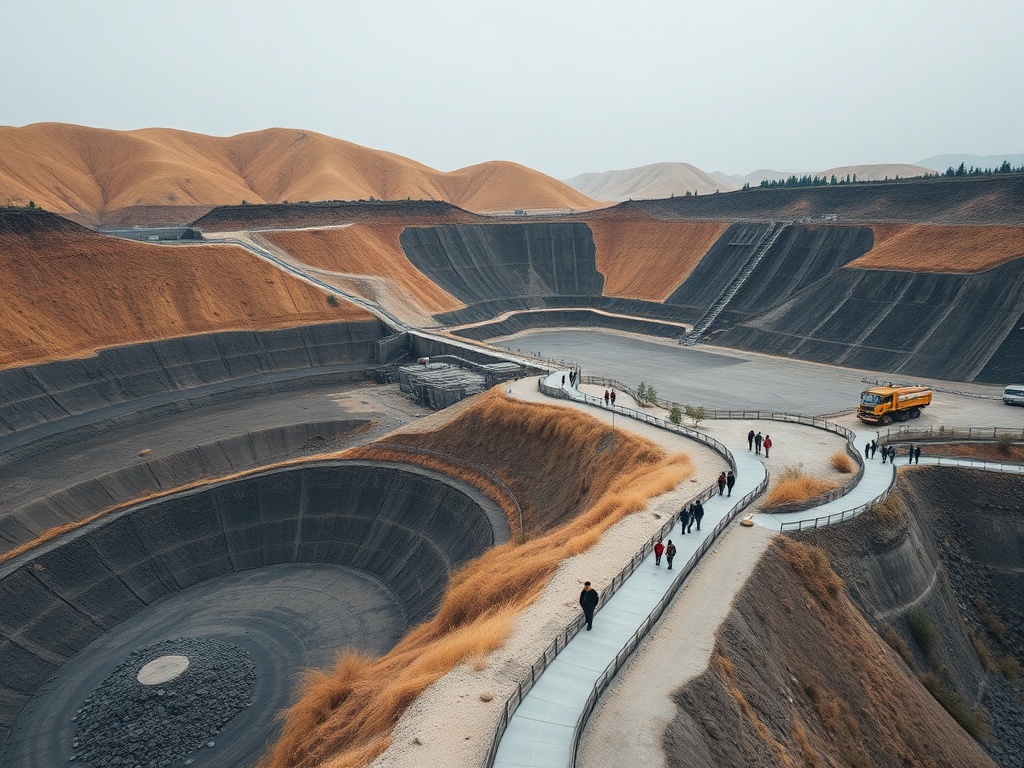
Since 2016, China has restored over 300,000 hectares of abandoned mines and designated 88 sites for tourism redevelopment since 2004. These figures sound appealing in a press release but encapsulate a basic economic question that available data does not clearly address: how much revenue does each rehabilitated hectare generate per tourist, and how long does it take to recover public investment? Without that metric, what we have is management of appearances rather than revenue replacement. Sources consulted openly acknowledge that business models for mining tourism are still experimental, and safety regulations hinder monetization. In financial terms: the asset has been repurposed, but the cash generation model remains unvalidated in the market.
The more accurate parallel isn’t a company diversifying its product lines; it’s a private equity fund selling an industrial asset at a loss and reinvesting the proceeds into an asset class with uncertain cash flows and low liquidity. The difference is that a fund can close if returns don’t materialize, while a region with three million dependent workers lacks that option.
Coal as a Backup, Not a Future
Here’s the data point that is most frequently misinterpreted in analyzing this transition: China added 78 gigawatts of new coal generation capacity in 2025. This figure coexists with the 1.9% drop in coal-based generation. The contradiction is merely apparent. The Chinese government is building coal capacity not for intensive use but to have it available as a backup for contingencies. Qi Qin, an analyst at the Center for Research on Energy and Air Quality, phrased it precisely: the government does not trust renewables enough as the sole source to commit to the country's energy security.
This fundamentally shifts the analysis framework. Coal from Shanxi is not being phased out; it's being redesigned to serve a different function, that of strategic reserve with decreasing utilization. It’s the business equivalent of maintaining an old production line at a low speed while the new plant ramps up. The issue for Datong is that this backup function generates less employment, fewer local tax revenues, and less derived economic activity than operating at full capacity. The region finds itself trapped in a middle ground: too much coal to be considered a diversified economy, but insufficient coal to sustain the level of employment and consumption that justified its urban infrastructure.
The solar and wind energy industries achieved in a decade what coal took a century to build. The levelized cost of solar energy has fallen by 77% since 2015; for wind, it's 73%. The combined installed capacity of wind and solar has reached 1,842 gigawatts. These costs won’t rise. What may increase is electricity demand from data centers and artificial intelligence, and that’s the only scenario where Shanxi coal recovers temporary utilization. However, building a regional strategy based on demand from data centers bets on a variable that depends on decisions made in Shanghai, Beijing, or San Francisco, not in Datong.
What Datong Reveals about the Management of Concentration Risk
Shanxi's situation serves as a manual on the deferred costs of industrial concentration. For decades, specialization in coal presented a clear competitive advantage; it generated economies of scale, attracted infrastructure investment, and created relatively high-quality jobs. However, the problem with advantages based on a single resource is that when the resource loses value, the entire structure is simultaneously exposed. There’s no internal segment to absorb the impact because everything is correlated with the same risk factor.
Regions and companies that survive these transitions aren't those that pivot fastest to the successor sector. They are those that maintain operational capacity in the mature sector while constructing alternative models with limited capital commitments, validating demand before scaling. Tourism in Datong may thrive; the Yungang Grottoes are genuine heritage with documented allure. But turning that into a proportional economic replacement for 1.3 billion tons of annual production requires an investment scale and timeline that available data still does not justify.
Shanxi is executing the only option available given its starting point: gradual diversification with coal serving as a transitional income source. The feasibility of that bridge depends on how long coal maintains sufficient utilization to finance the conversion without the associated public debt becoming unsustainable. With utilization factors dropping 12 percentage points in 14 years and projected to decrease another 16 points in the next decade, the room for maneuver is shrinking at a pace that the current rate of diversification cannot match.