
The Bluetooth Cockroach That Redefines the Cost of Teaching Neuroscience
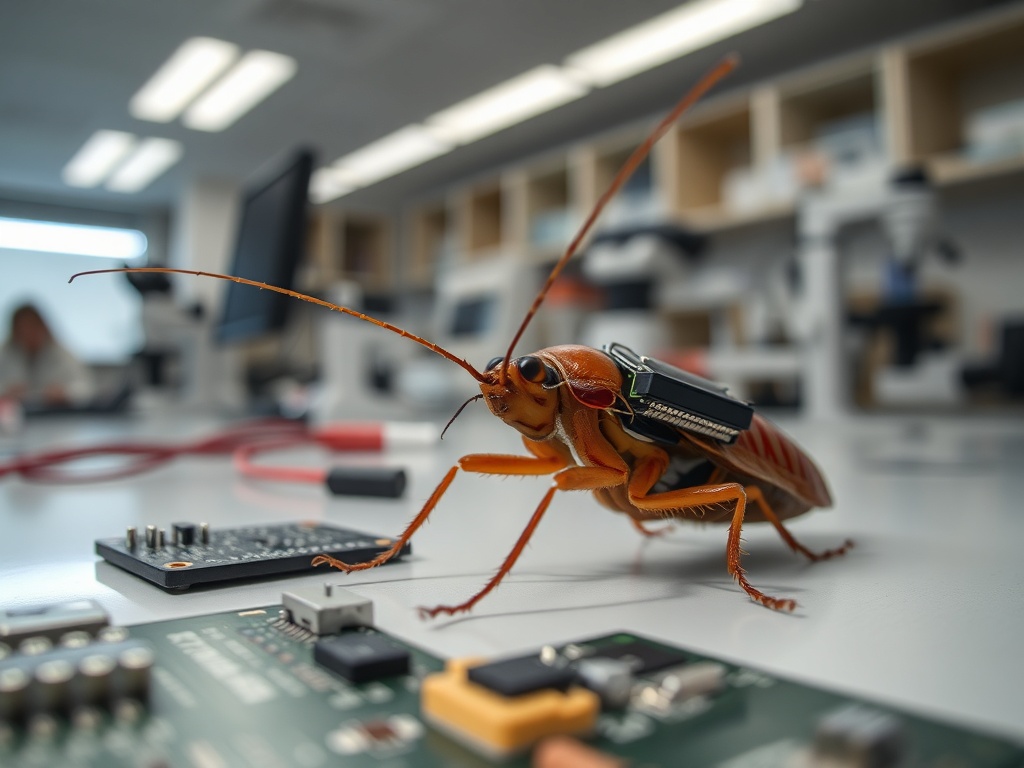
There is a precise moment when a technology ceases to be a curious experiment and becomes a structural signal. This moment does not always arrive from Silicon Valley with a nine-figure funding round. Sometimes, it originates from a university lab in Milwaukee, Wisconsin, where neuroscience students are learning about the nervous system not through computerized simulations or plastic anatomical models, but with living cockroaches equipped with Bluetooth backpacks.
What Marquette University is doing with these cyborg insects is not just pedagogically interesting. It is the clearest demonstration I have seen in months of how the marginal cost of producing a high-impact scientific learning experience can collapse to levels that would have seemed impossible a decade ago.
What Happens Physically in That Lab
The mechanics of the experiment are straightforward: students work with Madagascar cockroaches connected to a compact device, a kind of electronic backpack with Bluetooth connectivity, that allows them to record and transmit neural signals in real time. Students can thus observe, interfere with, and analyze how the insect's nervous system responds to various stimuli. This is not a simulation. It is applied electrophysiology, with a living organism, in real-time, in a university classroom.
The contrast with the standard educational model is stark. For decades, access to such experiences was restricted to research labs with equipment budgets that could exceed hundreds of thousands of dollars. Traditional electrophysiology instruments—amplifiers, precision electrodes, data acquisition systems—constructed a barrier that separated top-tier universities from practically everyone else. The hierarchy of neuroscientific knowledge was partially determined by who could afford the hardware.
A miniaturized device, mass-produced, and connected via Bluetooth obliterates that barrier. It does not merely reduce it; it destroys it. And when an entry barrier is destroyed, what follows is always a reconfiguration of who can participate.
The Collapse of the Unit Cost of a Scientific Experience
I want to be precise about what this means in economic terms because the narrative of "technology democratizes" often remains a slogan without grounding in the numbers that support it.
The cost of equipping a traditional neurophysiology lab for undergraduate students to have direct practical experience with real nerve signals is prohibitive for most institutions outside the global top 50. The historical result has been that millions of biology, medicine, and neuroscience students at universities in Latin America, Africa, or Southeast Asia graduated having seen those processes only in videos or textual descriptions. They absorbed the theory. They never touched the phenomenon.
When neural interface hardware fits in an insect's backpack and communicates via standard wireless protocols, the unit cost of that experience drops several orders of magnitude. The device can be replicated, distributed, and scaled. Knowledge that previously required fixed, expensive infrastructure can now travel. This is not generic technological optimism: it follows the same logic that led to the cost of sequencing a human genome falling from $100 million in 2001 to less than $1,000 in 2022. The learning curve of compact biotech hardware follows a known trajectory, and Bluetooth cockroaches are a data point on that curve.
The implications for the economy of scientific education are considerable. If the cost of replicating this type of experiment continues to fall, the financial argument for maintaining the geographic concentration of neuroscientific talent in a few wealthy universities weakens. Deans of science faculties in Bogotá, Nairobi, or Jakarta should view this experiment not as an anecdote but as a signal of what kind of infrastructure they will need—and what they will no longer need—in the next fifteen years.
Compact Biohardware and the Next Threshold
The Marquette experiment does not exist in a vacuum. It is part of a broader trend that could be termed the miniaturization of scientific instrumentation. In recent years, we have seen how devices that once occupied a room now fit in the palm of a hand: portable DNA sequencers, field microscopes using smartphones, cloud-connected water quality sensors. Each of these leaps followed the same pattern: dramatic reduction in unit cost, expansion of the potential user universe, and eventually, a reconfiguration of the market or institution that the instrument supported.
Neural interface biohardware follows the same trajectory. What is applied to cockroaches today in a pedagogical context is technologically contiguous to what could be applied within a decade to non-invasive brain interfaces for clinical diagnostics in low-resource settings. The distance between these two points is less than it seems, and universities training students with practical experience in accessible electrophysiology will be the ones producing researchers capable of shortening that gap.
There is also a governance dimension that deserves attention. As neural interface devices become smaller and cheaper, the regulatory perimeter that currently exists—built on the assumption that these technologies operate in well-defined clinical or formal research contexts—begins to become outdated. The regulatory frameworks of the FDA, the EMA, and their Latin American equivalents were designed for expensive, scarce hardware. Mass-produced, cheap hardware that can be distributed through standard commercial channels raises oversight questions that no regulatory agency has yet resolved.
The Hierarchy Being Broken Is Not Just Academic
I return to the central point because it deserves a reading that goes beyond the educational anecdote.
Marquette University is not simply finding a cheaper way to teach neuroscience. It is documenting, without necessarily intending to, how the compression of the marginal cost of scientific instrumentation redistributes epistemic power. Who can do science, where they can do it, and with what resources has historically been determined by barriers of physical capital. These barriers do not disappear overnight, but they erode with each iteration of more compact, cheaper hardware.
For leaders of educational institutions, venture funds in edtech, and governments designing scientific policy in emerging markets, the signal is concrete: the competitive advantage in scientific training is no longer built by accumulating expensive infrastructure, but by early access to compact hardware platforms that compress the cost of practical experience. Institutions that continue to plan their research capacity under the paradigm of the traditional high-fixed-capital laboratory are underestimating the speed at which that model is becoming obsolete.
The future of global scientific talent is formed in classrooms where a Bluetooth cockroach is enough to understand how a nerve works. Leaders who grasp this first will have a generational advantage over those who continue to wait for the budget for the perfect lab.