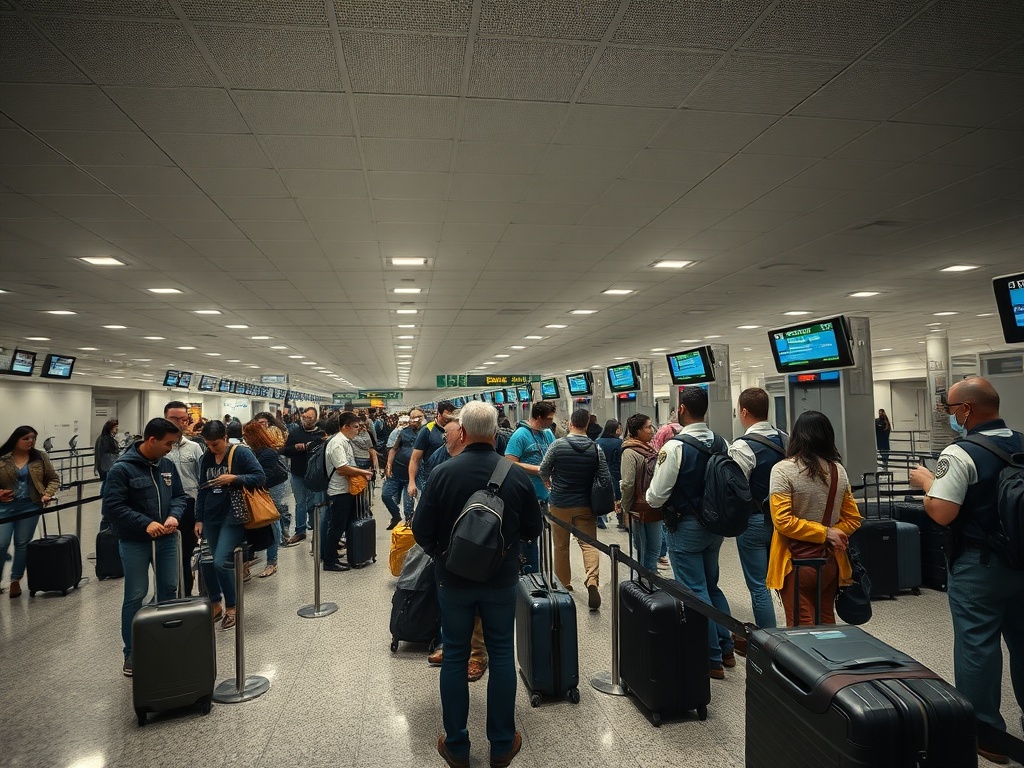

Airports as a Reflection of a Broken System
There comes a specific moment when an operating system ceases to be sustainable: when the demand it must meet grows, but its response capacity does not. At Baltimore-Washington International (BWI), that moment has already occurred. Lines at TSA checkpoints stretch for hours, staffing is inadequate, and travelers are caught in an infrastructure that simply wasn’t designed to handle the level of traffic it currently faces.
The headline points to a breaking point. What’s interesting is not the breaking point itself, but everything that had to not happen to reach this state.
When Revenue Engines Lack Operational Backing
The TSA is not a business, but it operates under a portfolio logic as recognizable as any mature corporation: it has a highly standardized core operation, budgets allocated by fiscal cycles, and a success metric historically measured by incidents of prevented security breaches rather than passenger experience or responsiveness to demand surges.
This design makes sense when the volume is predictable. It stops making sense when air traffic in the United States grows steadily, and staffing does not keep pace. What’s happening at BWI and other major airports across the country is not a sporadic management failure: it is the direct consequence of having over-exploited an operational model without investing in its capacity for scaling.
The underlying problem is architectural, not personal. When an organization concentrates its budget on maintaining today’s standard without reserving resources to redesign how it will operate tomorrow, any increase in demand becomes a crisis. And crises in public infrastructure have a cost that is hard to quantify but easy to feel: a loss of trust, accumulated friction, and a progressive deterioration of service perception that becomes structural.
From my perspective as a portfolio manager, this is the most costly pattern there is: organizations financing their present by silently and almost imperceptibly cutting their future maneuverability. It doesn’t happen all at once. It occurs budget decision after budget decision, fiscal year after fiscal year, until the system reaches its limit, and the only visible escape is an emergency resource injection.
The Trap of Measuring Operations with the Same Yardstick as Results
Here is where the diagnosis becomes more precise. One of the most common mistakes in large-scale organizations, whether public agencies or private corporations, is to apply the same efficiency indicators across all units without distinguishing between those needed to perform today and those that must build capacity for tomorrow.
In the case of the TSA, public conversation centers on wait times as a failure indicator. That is correct but incomplete. Wait time is a symptom. The root cause lies in not treating staffing and technological modernization of checkpoints as capacity investments, but as operational costs subject to budgetary constraints.
This distinction matters because it radically alters the resource allocation decision. An operational cost is contained. A capacity investment is financed with a long-term horizon and measured with different indicators: hourly throughput, saturation rate at peak times, average onboarding and training time for new staff. None of these indicators frequently appear in the standard efficiency reports of a government agency. And that absence is, in itself, a design data point.
Private companies operating critical infrastructure make the same mistake regularly. They concentrate their metrics on current quarter profitability and systematically neglect the indicators that predict whether the system will withstand the next growth cycle. When the system fails, public diagnoses always point to visible management. Rarely do they point to the governance model that produced that management.
Staffing Shortages as a Portfolio Decision, Not Bad Luck
News about BWI describes staffing shortages as a central factor in the crisis. From the outside, it sounds like a human resources problem. From within a portfolio analysis, it’s a more precise signal: it indicates that the organization did not dimension its talent pipeline with the same foresight as it did its projected demand.
Hiring, onboarding, and training staff for airport security operations is not a process that can be activated in weeks. It has certification timelines, learning curves, and turnover costs that any capacity planning model should account for. If there are shortages today, the decision that led to it was made twelve, eighteen, or twenty-four months ago. Not today.
This logic applies equally to any company managing labor-intensive operations. Operational talent is a capacity asset, not a variable to adjust. Organizations treating it as an adjustable variable discover, late and at a high cost, that replenishment takes exactly as long as they don’t have when demand has already ramped up.
The scenario described in airports like BWI projects a pattern that the private sector in infrastructure and logistics should heed. When demand for a service grows steadily and investment in operational capacity does not keep pace, the system does not degrade gradually and manageably. It degrades rapidly and visibly, exactly at the moments of greatest public exposure.
The Breaking Point is Always an Earlier Decision
What’s happening in U.S. airports has not come out of the blue. It arrived after years of budget allocation decisions that prioritized cost containment over investment in capacity, and a governance model that measures operational success with indicators that do not anticipate the stress of the system under increasing demand.
For any organization managing critical infrastructure, whether public or private, the design lesson is straightforward: an operational portfolio without sustained investment in future capacity is not efficient; it is fragile. And fragility does not reveal itself in normal days. It reveals itself exactly when it costs the most to reveal it.
The long-term viability of any intensive operations system depends on keeping the budget to maintain the present from consuming the entirety of the available margin to build the next version of the system. When this ratio is imbalanced for too many consecutive cycles, the breaking point stops being a possibility and becomes a date on the calendar.