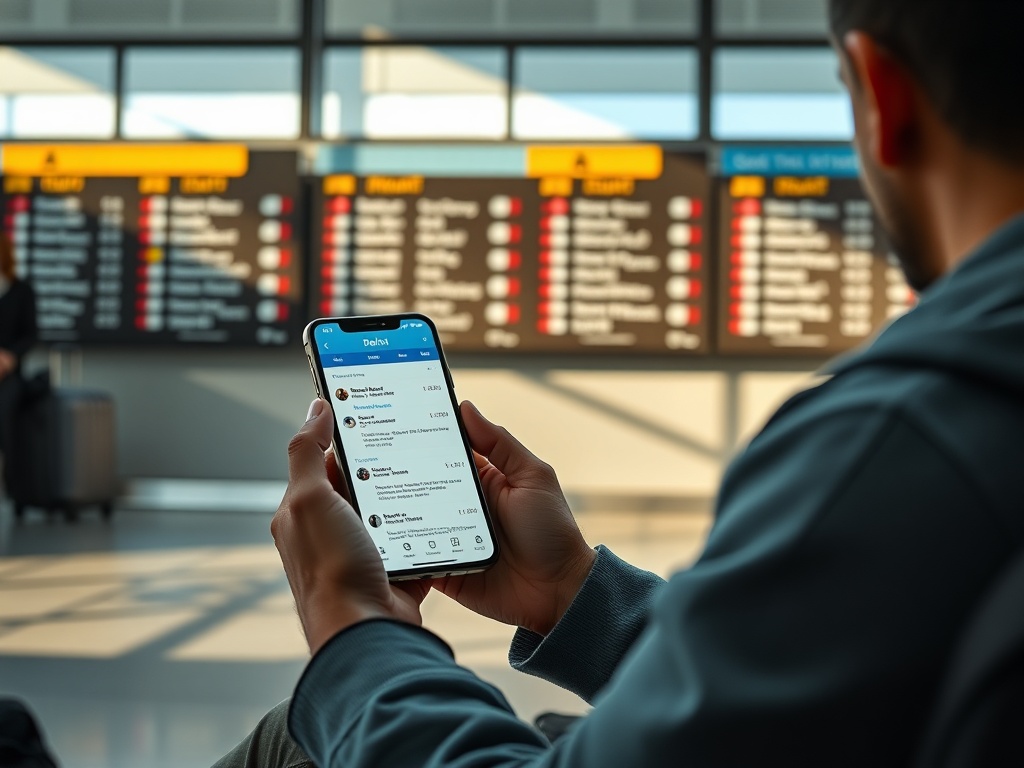

The Map is Redrawn Without Permission
There’s a statistic circulating among major tour operators that produces a peculiar discomfort: 60% of travelers in the Asia-Pacific already use artificial intelligence tools to research and book destinations. This is not a lab number or a projection from enthusiastic analysts. It’s a measurement of current behavior, and what it reveals is not enthusiasm for technology, but something much more concrete: a silent transfer of purchasing power.
When Priceline integrates OpenAI’s Advanced Voice Mode into its chatbot, or when Kayak launches conversational platforms to plan itineraries, the dominant narrative speaks of "enhancing user experience." It’s a comfortable framework. But the real movement taking place is different: the industry is competing to be the intermediary that AI will not eliminate. And that race has very specific winners, almost invisible losers, and a financial mechanics that few are reading honestly.
The generation of personalized itineraries solidified by 2025 emerged as the most frequent use of AI among travelers globally. Not price comparison, nor alerts on disruptions, nor automatic translation, though all of that exists and works. The dominant use is actually the one that historically justified the existence of a human agent: deciding what to do, when to do it, and why that destination over another. That role has just been colonized by a language model that charges no commission.
When the Distributor Becomes the Disposable Product
The economic model of organized tourism has been built for decades upon an asymmetry of information. The traveler does not know exactly which hotel has real availability, what the market price is, or what local experiences exist beyond the visible catalog. Tour operators and online agencies — the so-called OTAs — monetize that gap. Their margin is essentially the price the consumer pays for their ignorance.
Artificial intelligence does not merely democratize information: it structurally erodes that gap. And it does so in a way that superficial analysis tends to underestimate. Two-thirds of surveyed travel companies in 2024 were already using generative AI internally for data analysis. 63% of hotels applied it to optimize their revenue management. These numbers do not describe experimentation: they describe organizations learning to operate with a layer of intelligence that previously required teams of analysts or costly external contracts.
Here emerges a tension that the industry has yet to resolve openly. On one hand, large OTAs — Expedia, Booking.com — integrate AI to strengthen their personalized recommendations and retain travelers within their platform. On the other, that same technology, when applied to the small provider — the boutique hotel, the local experience operator — allows them, for the first time, to read customer preferences directly and contact them without going through the intermediary. The data clearly indicates: if traveler preferences are readable through AI analysis, the provider can engage directly with that traveler, offering precisely what that traveler wants.
That is not an operational improvement. It is a shift in who captures the value of the customer relationship.
Institutional Ego in the Mirror of Data
There is a recurring pattern in how large organizations face this type of displacement. They do not openly deny it, but neither do they act with the urgency the situation demands. What occurs in the intermediate space is more revealing: they build narratives of transformation that allow them to feel they are leading the change while, in practice, they continue to protect the model that gave them power.
Integrating AI in most established platforms has that texture today. AI is adopted to improve customer service — chatbots, voice assistants, recommendations — without touching the underlying value-capture architecture. The intermediary remains the intermediary, but now with a chatbot at the door. That is not transformation, it is cosmetic enhancement of a structure that feels the pressure but does not want to articulate in what direction it should move to avoid becoming redundant.
The case of Wipro and the Sukjai Assistant for the Tourism Authority of Thailand points towards something more honest: when a government decides to build its own AI tourism assistant, it is recognizing that the value of guiding the traveler should not belong to a foreign private platform. That is a conversation about data sovereignty that global OTAs prefer not to have out loud, because if that logic scales, the power map redraws itself significantly.
The real bottleneck is not in the available technology but in the organizations that have built institutional identities around being at the center of the customer relationship. AI does not destroy those identities. It makes them visible as what they always were: positions of power sustained by informational opacity, not by genuine differentiated value.
What the Industry Leader Has Yet to Admit to Themselves
There is a conversation that executives of major tour operators are precisely avoiding. It is not about which AI tool to adopt. It’s about whether the business they lead has a reason to exist in its current form once the asymmetry of information that sustains it completely disappears.
The tourism sector, largely composed of small and medium-sized enterprises, faces an additional challenge: AI-based personalization requires robust historical data, and a traveler who only arrives every two years does not generate enough of a history to be served accurately. This means that platforms that aggregate data from millions of users continue to have a structural advantage that cannot be eliminated simply by political will or democratic rhetoric.
But there’s a difference between having a structural advantage and having a guaranteed right to endure. Priceline betting on voice, United Airlines using AI to manage real-time disruptions, Concur automating corporate travel expenses: each of these moves signals that the most agile players understand that the future value is not in being the catalog, but in being the layer of intelligence that turns traveler preferences into frictionless decisions.
The tourism industry is not undergoing a technological improvement. It is experiencing a redistribution of who has the right to sit between the traveler and their destination. The leaders who will emerge strengthened from this period will not be those who adopt more AI tools, but those who have the rigor to honestly diagnose which part of their value proposition survives when their customer no longer needs them to know what they want or understand what is available.
The culture of any organization is a direct result of pursuing a purpose that justifies its existence, or the inevitable symptom of all the uncomfortable conversations its leadership postponed because answering them honestly would have forced a change to what they most wanted to preserve.