
AI No Longer Shows Products to Amazon: It Generates New Buyers
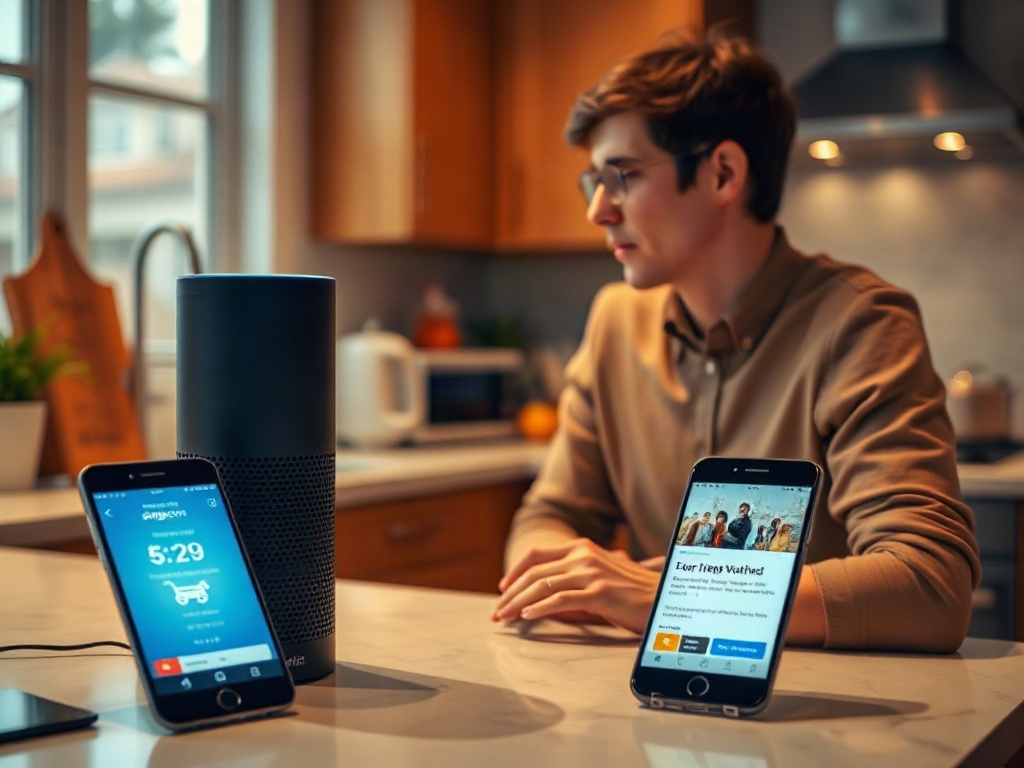
The most interesting analysis in Evercore ISI's note on Amazon is not found in the price target. It lies in a piece of data that, when read carefully, changes the very nature of the business: 57% of Alexa users with artificial intelligence capabilities purchased a product they were not aware of before interacting with the assistant. That is not efficiency in the buying process. It is demand that did not previously exist.
Mark Mahaney, senior analyst at Evercore ISI and one of the most closely followed voices in consumer technology on Wall Street, published a client note on August 28, 2026, in which he raised Amazon's price target from $315 to $355 per share, implying a potential upside of approximately 40% from the previous closing price. The justification did not rest on operational improvements at AWS or advertising margins. It rested on the results of the fourteenth edition of Evercore's annual digital retail survey in the United States, and on what that survey revealed about the concrete behavior of Alexa users with built-in AI.
The move received immediate backing: 64 of the 68 analysts covering Amazon had it rated as a buy or strong buy, according to LSEG data at the time of publication. The shares had accumulated a gain of 16% in the previous month and 27% over the prior six months. The market was already positioned. But Mahaney's note contributed something the consensus lacked: quantitative evidence that AI is changing purchasing behavior in the present tense, not in a future projection.
---
When the Assistant Stops Answering Questions and Starts Generating Needs
For years, the dominant mental model for voice assistants was that of facilitators: tools that accelerate a pre-existing intention. The user already wanted to buy AA batteries; Alexa simply placed the order faster. That version of the assistant is useful, but it does not change the economics of retail. It only compresses the time between decision and transaction.
What Evercore's data reveals is something structurally different. When more than half of Alexa AI users end up buying something they did not know they wanted, the assistant has ceased to be an execution channel and has become a demand generator. That difference is not semantic. It has direct implications for how the return on AI investment is measured, for how the product experience is designed, and for who wins in digital commerce over the coming years.
In the classical logic of e-commerce, the value of a platform is measured by its capacity to convert intention into transaction. Amazon optimized that equation over two decades with recommendation engines, fast delivery logistics, and reduced friction at checkout. But all those improvements operated on existing demand: users who arrived with something in mind and found the most efficient way to obtain it.
Agentic AI — a term Mahaney's note uses to describe systems that can execute complex tasks autonomously, including product discovery and purchase management without human intervention — operates in a different register entirely. It does not wait for intention. It constructs it. And when it does so with 36% of users reporting that they buy more in quantity following the integration of AI into Alexa, the impact ceases to be a marginal adjustment in the conversion rate and becomes an expansion of the total volume of commerce flowing through the platform.
This is what Mahaney describes as "additive": not a transfer of demand from one channel to another, but the appearance of demand that previously did not materialize because the user had not been exposed to the product or had not completed the cognitive process that leads to a purchasing decision. The assistant compresses or entirely eliminates that cognitive friction.
---
The 34-Point Gap That AI Could Turn Into a Moat
The Evercore survey also delivered a piece of competitive context data that deserves attention in its own right. 92% of respondents had used Amazon as an online shopping platform. Walmart, the next on the list, reached 58%. Thirty-four percentage points of difference in usage penetration between first and second place.
That number is not merely a snapshot of the current position. It is the starting point from which AI can operate. A platform with 92% penetration has access to a universe of purchasing behavior data — history, frequency, categories, seasonal preferences, responses to prior recommendations — that no competitor with 58% penetration can match in the short term. And agentic AI feeds precisely on that mass of data to improve the quality of its recommendations.
The strategic risk for Walmart and other competitors is not that Amazon possesses a technically more sophisticated AI function. The risk is that the data advantage Amazon accumulates with every Alexa AI interaction becomes increasingly difficult to replicate as the system learns. Every purchase of a previously unknown product made by an Alexa user feeds back into the model a preference signal that no external search engine captures with the same resolution. It is a self-reinforcing cycle: more users, more data, better recommendations, more generated demand, more users.
Walmart has strength in logistics, physical presence, and penetration in price-sensitive segments. But in the specific terrain of AI-mediated product discovery using proprietary purchasing behavior data, the distance it must cover is not 34 percentage points. It is structural.
This does not mean that Amazon's advantage is permanent, or that no vectors exist through which a competitor could mount an attack. It means that the vector chosen by Evercore ISI to justify the upward revision of the price target — AI as a generator of incremental demand — is also the vector most difficult to replicate for any actor that does not start with a purchasing behavior database of the same order of magnitude.
---
The $355 Price Target as a Hypothesis About a New Growth Model
A price target increase from $315 to $355 is not merely a revision of financial assumptions. It is a statement about the nature of Amazon Retail's future growth. Mahaney is saying, backed by concrete survey numbers, that the ceiling of commerce flowing through Amazon is higher than previous models contemplated, because AI is creating categories of demand that previously did not exist within the platform.
That argument holds if the condition sustaining it remains in place: that the 57% of users purchasing unknown products and the 36% buying more in volume are not novelty effects that dilute over time, but rather changes in usage patterns that consolidate as the assistant learns the user's preferences more effectively. The survey captures a specific moment. What the coming quarters will reveal is whether those numbers hold, grow, or erode once the novelty effect normalizes.
The structural question the market will need to answer in Amazon's next earnings presentations is whether Retail growth can be verifiably attributed to Alexa AI adoption, and whether that attribution appears in the metrics the company reports: purchase frequency, average order value, repurchase rate in categories that are new to the user. If those indicators accompany Evercore's narrative, the hypothesis moves from survey to operational evidence. If they do not appear, the upward revision of the price target will have anticipated an effect that the business has yet to translate into measurable revenue.
What is already clear from this point forward is that the long-term investment thesis on Amazon has ceased to revolve exclusively around AWS and advertising margins. AI embedded within the end consumer's shopping experience has become a third engine that analysts are beginning to price in with their own data, not merely with narrative. That changes the type of questions worth asking of the company's quarterly results.
---
What the Alexa User Contracted Without Knowing It
There is a way of reading these numbers that goes beyond stock analysis. When an Alexa user purchases something they did not know they wanted, they are contracting something very specific: the elimination of the effort of discovery. Not the product itself, but the process that normally precedes it — searching, comparing, evaluating, deciding — compressed or delegated to an agent that knows their history and can make a recommendation with greater context than the user themselves could articulate at that moment.
That is what agentic AI sells, even if it does not describe itself in those terms. And it represents a concrete functional advance in the life of someone who has less time available to navigate options, who trusts that the platform knows their preferences well enough, and who is willing to cede part of the control over the purchasing process in exchange for speed and relevance. The 57% who bought something unknown were not manipulated. They contracted cognitive convenience, and the resulting transaction proved satisfactory.
The long-term risk for the user — and the point at which this dynamic could break down — is if the agent's recommendation begins to prioritize Amazon's margins over the user's genuine preferences. When that happens, trust in the assistant erodes and purchasing behavior returns to the hands of the user. For now, Evercore's data suggests that threshold has not been crossed. The assistant continues to be perceived as useful, not as a salesperson.
That perception is the most fragile and most valuable asset Amazon holds in this new phase of its retail business.