
The World's Most Expensive Plan with No Dollars on the Table
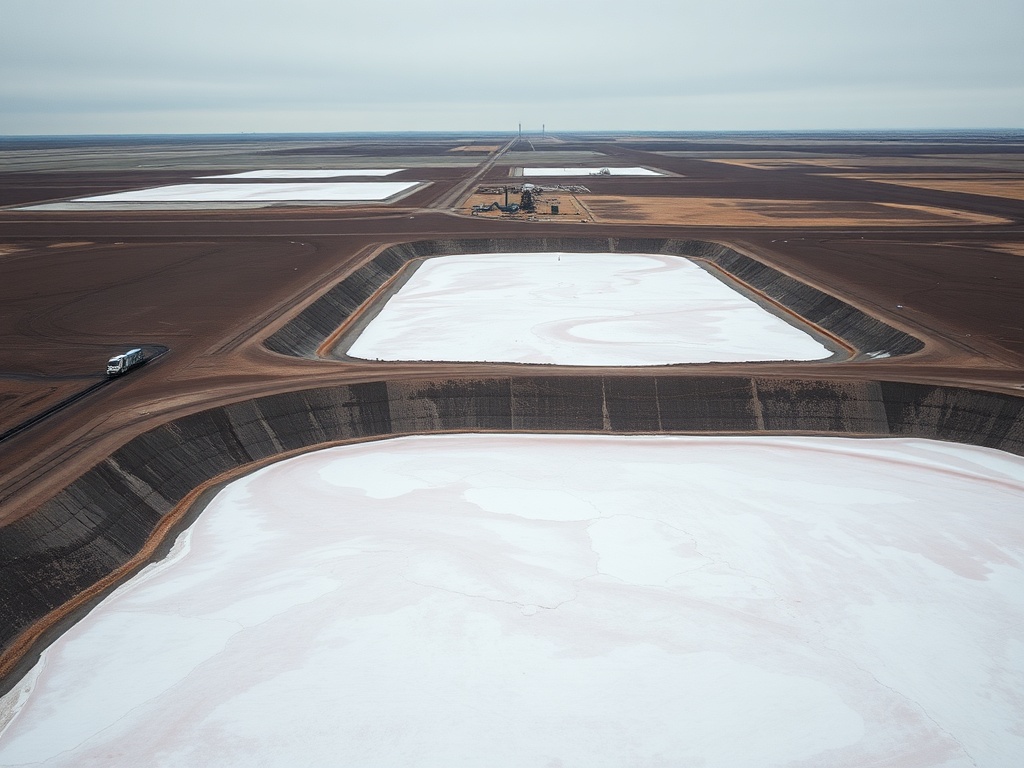
Karnalyte Resources wrapped up 2025 with what any conventional analyst would call a milestone: the completion of a feasibility study projecting a 70-year mine lifespan, a net present value after taxes of $2.04 billion at an 8% discount rate, and an internal rate of return of 12.5%. The Wynyard project, located in Saskatchewan, Canada, is set to produce 2.175 million tons of potash per year plus 104,000 tons of hydromagnesite at full capacity. The numbers look impressive on paper. The total capital required amounts to $4.19 billion, divided into three phases for processing potash, plus a hydromagnesite facility.
What stops me is this: that document was prepared by Wood Canada Limited, ERCOSPLAN, RESPEC Consulting, and March Consulting Associates. Four engineering firms, dozens of geologists, financial modelers, and infrastructure experts. The result is a first-rate technical artifact. Yet, all that precision rests on a demand hypothesis that hasn't been tested with real money on the table from any buyers, save for an offtake agreement with GSFC, the Indian partner who is already a shareholder in the company.
I’m not questioning the geology. The measured and indicated reserves of 777.1 million tons with an average grade of 12.4% K₂O are well documented. The issue isn’t what lies underground. The issue is what happens between that resource and the global fertilizer market over the next seven decades.
The GSFC Agreement Is Not Market Validation, It's Political Risk Mitigation
Karnalyte’s CEO, Danielle Favreau, highlighted in the statement the strategic alliance with GSFC as one of the cornerstones of the project. And she is right to mention it: Gujarat State Fertilizers and Chemicals is a state-owned Indian company, a shareholder of Karnalyte, and a signatory to an offtake agreement. Amid a context where the governments of Canada and India announced in February 2026 a renewed collaboration in the fertilizer sector, that connection holds political and signaling value.
However, an offtake agreement with a shareholder is not the same as a market that has chosen your product over competitors at a price that justifies a $4.19 billion initial investment. GSFC has not put that money down yet. Nobody has. What exists is a document that states that, under certain potash price conditions, a specific discount rate, and certain operational assumptions, the project generates value. That is exactly what any ambitious business plan promises before reality intervenes.
The global potash market in 2026 is being shaken by geopolitical volatility, disruptions in shipping routes, and pressures on natural gas prices that affect nitrogen fertilizer production costs. Karnalyte acknowledges this in its own update. What it doesn’t address is what happens to its 12.5% IRR if potash prices fall by a sustained 15% during the construction phase, which the study itself implies involves a fixed cost structure of several billion before selling the first ton.
Seventy Years of Projections Based on Assumptions that Change Quarterly
There’s something that generates professional friction for me when I see financial models with a 70-year horizon. It’s not that they are poorly done. It’s that the level of confidence they convey is inversely proportional to their actual predictive utility.
Long-term models in mining are necessary to comply with regulators, attract institutional capital, and demonstrate that the resource has enough scale to justify the infrastructure. I understand that. But the operational risk of a project of this magnitude does not live in year 40 of the model. It lives in the decisions over the next 36 months: when financing closes, at what rate, with what debt-equity structure, under what reference potash price, and with what additional buyers beyond GSFC.
The sale of non-strategic agricultural assets for $1.4 million and the resolution of pending litigation demonstrate that the team is cleaning up the balance sheet to appear more attractive to financiers. These are correct management moves. But $1.4 million in a project that needs $4.19 billion is a decimal percentage of the required capital. The real work of financial validation has yet to begin.
What Karnalyte needs now is not another comprehensive study. It needs the mining equivalent of an irrevocable purchase commitment from a second client who is not a shareholder, at a price that can at least support the first construction phase. That data, more than any NI 43-101 update, would be the signal that capital markets need to take this project seriously as a candidate for competitive project financing.
Saskatchewan Is the Real Advantage; Execution Strategy Remains a Hypothesis
There’s one aspect that works clearly in Karnalyte’s thesis: the jurisdiction. Saskatchewan is no small detail. It is the second-largest potash reserve in the world, with established export infrastructure, a mature regulatory regime, and a reputation for stability that no Belarusian or Russian producer can offer today. When global fertilizer markets seek supply certainty, Wynyard’s geography is a genuine asset.
It is also true that the ability to produce hydromagnesite as a byproduct of the potash process adds a second revenue source that few potash projects can offer. 104,000 tons per year of hydromagnesite at full capacity targets flame retardant markets, chemical industry, and construction materials. This diversifies the revenue profile on paper. But it also multiplies operational complexity and requires building a network of buyers in markets where Karnalyte has no established commercial presence.
The pattern I see is a company with a first-class geological asset, a valuable strategic partner, and a flawless technical study, that still has not resolved the central problem of any capital-intensive project at this scale: to demonstrate that there is enough paying demand, contractually committed and at prices that support the cost structure, before starting the detailed engineering phase. That is the missing experiment. Not another report.
Leaders building lasting businesses learn to distinguish between the certainty provided by a model and the certainty provided by a signed contract with a customer. Only the latter moves real capital. The most elaborate plan in the world remains a hypothesis until someone pays for what it promises.