
Why Silicon Valley Is Funding the War the Pentagon Doesn't Know How to Fight
During four weeks of conflict with Iran, the United States fired approximately 850 Tomahawk missiles. The Pentagon's replenishment rate was around 90 per year. The arithmetic is brutal: the country consumed nearly a decade's worth of production in a single month of operations. That number, cited by Brian Schimpf, chief executive officer of Anduril Industries, during the Fortune Brainstorm Tech 2026 conference in Aspen, is not a logistical audit figure. It is the diagnosis of an industrial base that has spent decades operating under assumptions that modern warfare has rendered obsolete.
What emerged from that roundtable was not a technical debate about supply chains. It was the public articulation, by investors and executives with direct positions in the sector, of an uncomfortable thesis: the United States' defense acquisition and production model was designed for a type of conflict that no longer exists, and the frictions that constrain it today are not matters of engineering but of institutional architecture and leadership.
---
The Cost of Not Having Had That Conversation Sooner
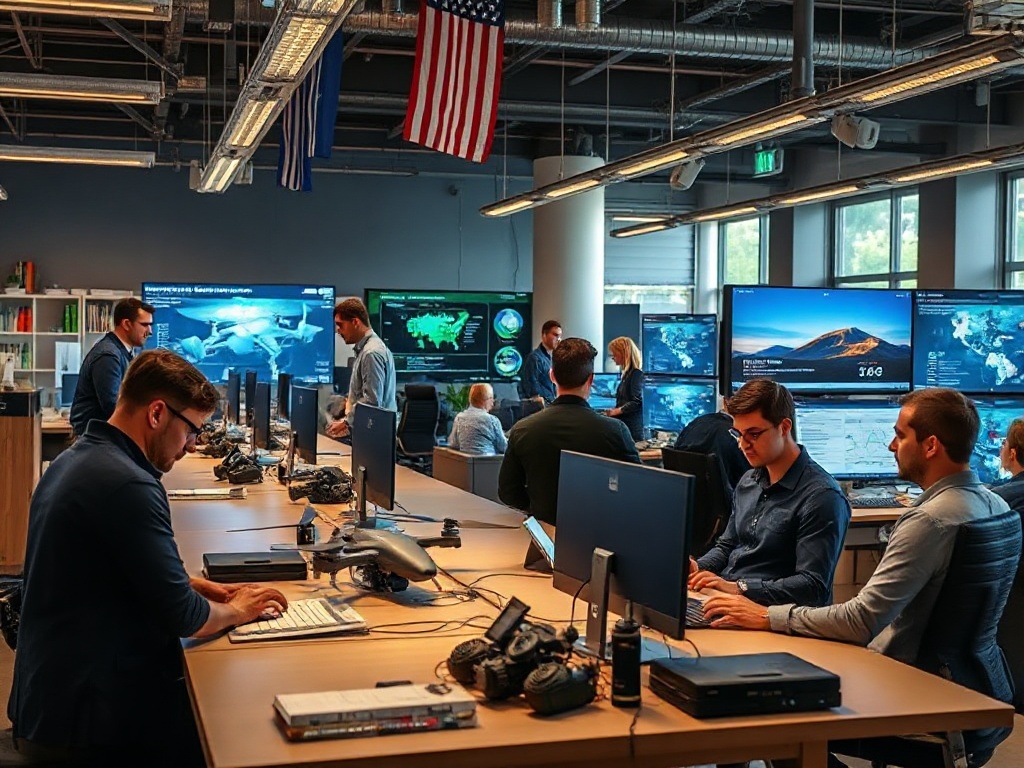
Jon Garrity, chief executive officer of Tagup, a defense technology startup that originated at MIT, frames the issue from the angle of measurement. He notes that, for the first time, advances in artificial intelligence and sensor capability make it possible to connect industrial inputs and outputs in ways that were previously impossible: knowing in real time what a production line is producing, what it is consuming, what is failing, and what is conditioning the operational availability of a weapons system. This is not a speculative claim. It is a description of what Tagup concretely does with industrial and military assets.
The problem Garrity identifies is not technological. It is earlier than that. For decades, the Pentagon acquired capabilities under a logic of singular platforms, multi-year contracts, and development cycles of ten to fifteen years. Within that framework, there was no incentive to measure industrial productivity in real time because the scale and speed of consumption did not demand it. The conflict with Iran, as the source indicates, demonstrated that this assumption no longer holds.
Aidan Madigan-Curtis, partner at the venture capital fund Eclipse, puts figures to the imbalance with China in another domain: tactical drones. "They have tactical drone capability thousands of times greater than ours," he stated during the panel. "They are the only ones with a robust robotics ecosystem. We don't have that capacity here." This is a statement that deserves to be read carefully. It does not come from a foreign policy analyst. It comes from someone who allocates capital to companies competing in that space and who therefore has incentives to understand the reality of the market with precision.
What Madigan-Curtis describes is not merely a technological gap. It is the accumulated result of not having made difficult decisions in time: not having invested in the manufacturing of low-cost autonomous systems when the commercial cycle made it viable, not having built the industrial fabric that China constructed through decades of sustained industrial policy. That conversation — about when and how to reorient the manufacturing industrial base toward high-cadence autonomous systems — was postponed in Washington during the period when it would have been least costly to act.
---
Venture Capital as a Substitute for Industrial Policy
The thesis that emerges from the Brainstorm Tech panel follows a specific financial logic: given that the state was unable to modernize its industrial base through traditional acquisition mechanisms, private venture capital is being called upon to fill that void. Teresa Carlson, chief executive officer of the General Catalyst Institute, represents precisely that articulation: an institutional structure that attempts to bridge the logic of venture capital funds with the capability needs of the public defense sector.
This is not philanthropy. It is a reconfiguration of the market. If the Pentagon opens more agile acquisition channels for startups and dual-use technology companies, the addressable market for funds like Eclipse, General Catalyst, and others investing in defense expands considerably. Tagup, True Anomaly, Anduril Industries: these are companies backed by private capital that need access to long-term government contracts to demonstrate economic viability.
The dynamic has an internal tension worth naming explicitly. Venture capital funds operate under return horizons of five to ten years and exit expectations via acquisition or public market listing. Defense programs operate under horizons of twenty to thirty years, with security requirements, regulatory compliance, and political accountability that bear no resemblance to the mechanics of a Series B financing round. The risk, therefore, is not only that the state will fail to adopt technologies at the necessary speed. It is also that the startups receiving that capital will overstate their current capabilities in order to capture contracts they subsequently cannot execute at the required scale.
The case of True Anomaly, cited by Madigan-Curtis, illustrates the bet. The company is developing a constellation of attack satellites for the United States Space Force. It is a technology that has no proven operational precedent at scale. The government contract grants it legitimacy. The venture capital gives it development velocity. But between the two logics lies an execution gap that no pitch deck closes.
---
Rare Earths, Single-Supplier Dependency, and What Nobody Wanted to Audit
Beyond drones and missiles, the panel identified two structural vulnerabilities that share a common characteristic: they are the result of cost-optimization decisions made decades ago that no one seriously reviewed until the geopolitical context made them urgent.
The first is the dependence on China for rare earths and strategic minerals. China controls a majority share of the global extraction and processing of these elements, which are indispensable components in electric motors, guidance systems, defense electronics, and battery technology. The panel emphasized that Beijing has used that control as a political instrument. This is not a theoretical threat: Chinese restrictions on the export of strategic materials in recent years constitute a documented precedent.
The problem is not that the United States did not know this. The problem is that for years the response consisted of gradual diversification, impact studies, and pilot programs for reactivating domestic mining, rather than sustained investment in domestic processing capacity or in alliances with third countries. The conversations that flagged this risk existed. They were simply not acted upon with the proportionality that the risk demanded.
The second vulnerability is more operational: for high-value systems such as large naval vessels, the majority of components depend on a single supplier. This means that any disruption in the chain — whether from a natural disaster, conflict, supplier failure, or deliberate action — can halt the production of platforms that cost billions of dollars and take years to build. In civilian industrial manufacturing, that level of concentration in a single supplier would have triggered an immediate risk audit. In defense, the inertia of the program and the acquisition bureaucracy sustained it as standard practice for decades.
---
What AI Can Measure That the System Preferred Not to See
Jon Garrity asserts that artificial intelligence now makes it possible to do something that was previously structurally impossible: to link industrial inputs in real time with operational availability indicators. To know which part of a production chain is limiting response capacity, where bottlenecks exist, how long it takes to replenish a critical component, and what the downstream impact of that is on the actual readiness of the defense system.
That capability has concrete value. But it also reveals something that sector leaders should process with care: if we can now measure all of that, it means that for years we made acquisition decisions, budget programming decisions, and industrial policy decisions without that visibility. Not because the technology did not exist in any form, but because the system had no incentive to build it, nor to act on what it would have revealed.
AI as a supply chain visibility tool is not a solution in itself. It is a mirror. What it reflects is the accumulation of unreviewed assumptions, unaudited dependencies, and efficiency decisions that optimized for cost in peacetime at the expense of resilience in times of crisis. Garrity says this "is going to rapidly transform the way we think about the supply chain." He is probably right. But transforming the way of thinking is only the first step. The real friction begins when that visibility forces decisions that alter established contracts, redistribute budgets, and challenge the actors who benefit from the status quo.
Madigan-Curtis also noted that advances in AI are forcing Washington to construct regulatory frameworks in real time. President Trump signed an executive order establishing a voluntary national security review process for the most advanced AI systems prior to their public release, for a period of up to one month. Anthropic withheld its most advanced model, Claude Mythos, from public distribution until it had completed testing with selected private partners, launching in June 2026 a version the company describes as "safe." These moves are not isolated events. They are indicators that the pace of AI development is outstripping the capacity of institutional frameworks to evaluate it, and that defense is the domain where that gap carries the most immediate consequences.
---
The Organizational Cost of Optimizing for Peace
There is a pattern running through each of the problems described in Aspen, and it is not technological or financial in nature. It is organizational.
The munitions depots that were not modernized since World War II did not fail to modernize due to a lack of available technology. The single-supplier dependencies in naval platforms were not created because no one understood the concentration risk. The gap in tactical drone manufacturing is not the result of ignoring what China was building. In each case, there were people inside the system who had sufficient information to see the problem. What was missing was the institutional willingness to bear the cost of acting on that information.
Optimizing for peace has a perfectly rational internal logic. Defense budgets face constant political pressure. Planning cycles favor continuity over restructuring. Long-term contracts with major contractors create institutional dependencies that are costly to dismantle. And conversations about structural vulnerabilities have the effect of generating urgency in contexts where urgency carries a political cost.
What the Fortune Brainstorm Tech 2026 panel named — with concrete data and from positions of deployed capital — is that this cycle of postponement has a limit. The speed with which Tomahawk missiles were exhausted, the magnitude of the tactical drone gap, and the fragility of strategic mineral supply chains are not risk projections. They are measurements of a deficit that is already active.
The venture capital now flowing toward Anduril, Tagup, True Anomaly, and their peers is not betting on a market opportunity in the abstract. It is betting that the defense acquisition system, under sufficient geopolitical pressure, will be forced to open itself to forms of industrial organization it cannot generate on its own. That bet may well be correct. But its correctness depends on whether the leaders inside the system have the willingness to name, with the same precision this panel employed, what their organizations have preferred not to see.