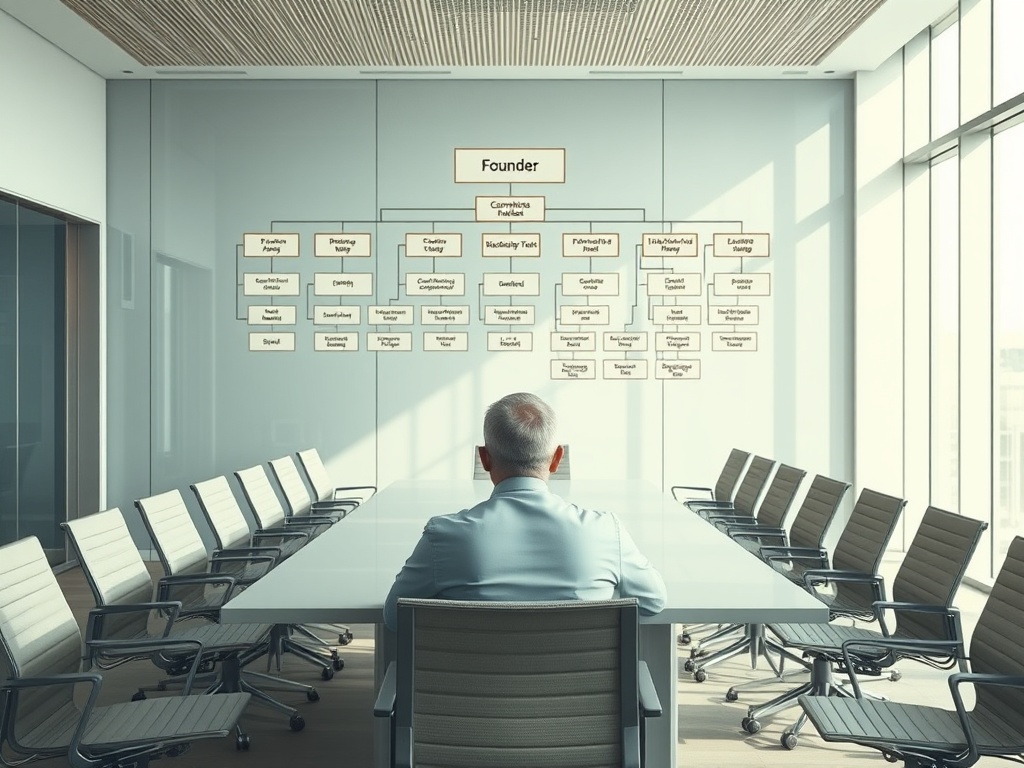

When the Founder Becomes the Bottleneck of Their Own Company
Måns Jacobsson Hosk spent a decade building Kurppa Hosk alongside Thomas Kurppa until it became a globally recognized creative agency. There was no scandal, no financial collapse, no board of directors pushing him toward the exit. What there was, was something far less dramatic and, precisely because of that, far more difficult to diagnose: the company had stopped growing at the speed it could, and the reason had a name and a face. Jacobsson Hosk himself describes his style as direct, interventionist, and grounded in constant dialogue. In the early stages, that is the description of a functional founder. In an organization that needs to scale, it is the description of a systemic failure point.
The decision to step down from the CEO role was voluntary and, according to what he himself has documented, deliberate. The timing coincided with the creation of Eidra, an advisory collective that absorbed Kurppa Hosk within a structure comprising 30 companies, 1,400 people, and 14 offices. Jacobsson Hosk moved into the role of co-CEO of Eidra, focused on vision and creative leadership. In operational terms: he stopped managing and started orienting.
What this case allows us to dissect is not a story of executive humility. It is a case study about when a company's organizational structure becomes trapped inside the mental model of the person who founded it, and what it takes for that trap to be broken from within.
The Moment When the Founder Stops Being an Asset
There is a blurry line between the founder who keeps their finger on the pulse of the business and the founder who, without intending to, centralizes every decision because teams have learned that is simply how things work. Jacobsson Hosk identifies that line with precision when he describes the problem: the teams could not become autonomous, layers of leadership were not emerging, and the organization kept revolving around his perspective instead of evolving beyond it.
This is not a personality phenomenon. It is an organizational architecture phenomenon. When the founder makes decisions faster than any formal process can, teams stop developing their own judgment because they do not need to. The result is not insubordination or incompetence: it is atrophy from disuse. The best talent eventually leaves because there is no real space to grow. Those who stay learn to execute instructions, not to generate direction.
Harvard Business Review cites that 58% of founders struggle to relinquish control, but that figure captures only part of the problem. The most costly part is not the psychological resistance, but the time that passes between the moment the dynamic takes hold and the moment someone names it. In most cases, that period can stretch for years. During that time, the company functions, delivers, and even grows. Except that it does so below its true potential and, gradually, accumulates a structural dependency that becomes increasingly expensive to dismantle.
Research by Noam Wasserman of Harvard Business School documents that founders who remain as CEOs through successive funding rounds reduce their companies' valuations by an average of 17% to 31%. This is not a data point about intention or moral competence. It is a data point about the gap between what the founder can offer at each stage and what the company needs at that same stage.
Why Most of These Transitions Fail Before They Are Even Attempted
The problem with founder-to-CEO transitions is not that founders are unwilling to let go. The problem is that most organizations do not build the conditions for a transition to happen before it becomes urgent. When the process is triggered under pressure, the available options are worse, the timelines are worse, and the internal narrative tends to collapse in on itself.
The Jacobsson Hosk case is atypical because the external pressure was minimal. Kurppa Hosk was not in crisis. There were no investors pushing nor metrics in the red. What there was, was an honest diagnosis about a dynamic that, if left uncorrected, would lead to stagnation. That capacity to act on a latent problem before it becomes acute is, from an operational validation perspective, far more difficult to replicate than reacting to a crisis.
Most failed transitions share a pattern: the founder nominally agrees to step away from the operational role but does not let go of the information flow. They continue to be the first call in difficult decisions. They continue to be the informal arbiter of internal conflicts. The title changes; the decision-making architecture does not. In those cases, the new CEO operates in an ambiguous territory where their formal authority does not align with their real authority, which deteriorates their capacity to drive change and, sooner or later, pushes them out.
Jacobsson Hosk describes a different solution: identifying a successor who is a custodian of the company's culture, not merely an efficient operator. The distinction matters. An operator can manage the existing business. A cultural custodian can grow it in a direction that preserves what gave it its identity. Eidra, as a collective structure, facilitates this process because it has a leadership pool broad enough to identify profiles simultaneously by skills, values, and cultural fit — something a small organization can rarely do.
What Eidra Reveals About the Transition Model That Is Coming
The existence of Eidra as a framework is not a secondary detail in this analysis. It is the variable that makes Jacobsson Hosk's transition possible without leaving Kurppa Hosk exposed. A company that relinquishes its founding CEO without an organizational network to absorb that talent and rechannel it elsewhere typically faces two outcomes: the founder returns because there is nowhere else to go, or the company loses access to the capacity that founder represented.
The advisory collective model that Eidra represents — 30 companies, expertise distributed across strategy, creativity, and technology — builds a layer of talent mobility that individual organizations cannot sustain on their own. In terms of financial architecture, it converts what would normally be a fixed cost of retaining senior talent into a distributed capability that can be activated as needed. The founder does not disappear: they change function within a broader system.
This has direct implications for any organization considering a similar transition. The operational question is not whether the founder is ready to step back. That question arrives too late and is poorly framed. The question that must be resolved in advance is where that founder will operate afterward, what kind of structure absorbs their energy, and whether that structure already exists or needs to be built. Without an answer to that, most transitions become departures, and departures produce vacuums that teams take years to fill.
Jacobsson Hosk describes it with a phrase that deserves to be taken seriously from an organizational design perspective, not from a motivational rhetoric standpoint: "the company did not need more of me. It needed a different me." What that phrase conceals is a substantial amount of prior work that the narrative does not detail: mapping which functions were tied to his person, which could be delegated through a clear process, which required a different profile, and which could simply be eliminated because they only existed because he had the habit of executing them.
That role audit is, in practice, the hardest work in the entire transition. Not because it is technically complex, but because it forces a distinction between what the founder does because it is necessary and what they do simply because it is what they have always done. That distinction can rarely be drawn from the inside without deliberate friction with someone who has the incentives to say what the founder does not want to hear.
The Moment of Believing Without Data Still Has a Measurable Cost
There is a pattern that consistently appears in cases where transitions are postponed for too long: the organization builds an internal narrative about why the founder remains indispensable before having any evidence that this is true. It is not a conscious or malicious decision. It is the natural result of operating in an environment where the founder has been the source of nearly every important decision for years. Teams internalize that dependency as part of the normal functioning of the business, and when someone points it out, the spontaneous response tends to be: "but the thing is, they understand things that nobody else understands."
That argument may be true. But it is also the most convenient formulation for avoiding the work of transferring that knowledge, documenting those criteria, and building the capabilities that would allow other teams to make those same decisions with comparable information. When an organization reaches that point and does not question it, strategic planning ceases to be an exercise in exploration and becomes an exercise in justification. The outcome of the plan is known in advance because the plan always concludes that the current model, with the current leadership, is the correct one.
The cost of that pattern is measurable even though it is rarely measured. It accumulates in decisions that are delayed because someone has to wait for the founder, in mid-level leadership profiles who leave because they find no space to grow, in market opportunities that are passed over because the evaluation process requires more consensus than the structure can generate with speed. It does not produce a single critical event. It produces a slow erosion of competitive capacity that only becomes visible when someone makes the comparison with what the company could have been.
Jacobsson Hosk's transition is not a replicable manual in all its details because the conditions that made it possible — including the existence of Eidra as a safety net — are specific to that context. What is replicable is the logic that preceded it: diagnosing how much of what the founder does is structurally necessary and how much is simply the result of not having built alternatives. That distinction, made with data rather than intuition, is what separates a transition that strengthens the organization from one that merely changes the name on the org chart.