
When Energy Earns What Technology Cannot Guarantee
On the first day of June 2026, the American stock market left behind an image worth more than any macroeconomic report: while Intel fell 4.05% and Texas Instruments lost 4.73%, Nvidia rose 4.87% and Micron Technology surged 5.90%. On that same day, Exxon Mobil gained 2.64% and Chevron 2.68%, with a consistency that the technology sector was unable to replicate. Technology fragmented. Energy advanced as a bloc.
That is not market noise. It is a signal about what institutional investors are seeing with far greater clarity than they did three years ago: the growth of artificial intelligence has a physical bottleneck, and that bottleneck is not in the algorithms or the chips. It is in the electrical grid.
The heatmap of June 1st is, in that sense, a mirror of a structural tension that has been building ever since large-scale language models began consuming energy at an industrial scale. What the session revealed was not a capricious rotation of portfolios, but rather a fairly sophisticated reading of where the real bottlenecks in technological growth lie over the coming years.
Technology Has Ceased to Be a Single Bet
Five years ago, "investing in technology" had a reasonably uniform logic: betting on the growth of digital platforms, software, and semiconductors as if they were a single rising tide. On June 1, 2026, that simple reading model no longer worked.
Oracle rose 4.26% and Microsoft 2.52%, while Google fell 1.20% and Meta Platforms retreated 3.50%. Within semiconductors, the same disparity appeared: the day's winners are those most directly exposed to demand for artificial intelligence infrastructure, while the losers are manufacturers of more general-purpose chips or companies that depend on digital advertising revenues.
What this reveals is an internal segmentation of the technology sector that the market was slow to process but is now pricing with considerable precision. Nvidia and Micron Technology are not being bought for their consumer products or their historical margins: they are being bought because they are direct suppliers of an infrastructure that has no short-term substitute. The data centers that train and serve AI models require graphics processing units and high-speed memory, and demand for both exceeds installed production capacity.
Intel, by contrast, has spent years trying to recover ground in markets where it lost position to competitors with more efficient architectures. Texas Instruments, an excellent company with decades of profitability, primarily serves industrial and automotive markets where the demand cycle is slower and more predictable, but where the AI explosion does not translate directly into urgent orders. The market is not punishing them for being bad companies: it is punishing them for not being in the right place on the demand map at this specific moment.
The case of Google and Meta is equally revealing. Both companies have massive exposure to AI: Google with its own models and Meta with its bet on LLaMA and generative AI across its platforms. But their primary revenue engine remains digital advertising, and investors appear to be discounting pressure on that front — whether due to a macroeconomic environment compressing marketing budgets, or due to uncertainty about how generative AI redistributes user attention and, with it, advertising inventory. There is a notable irony in that movement: two of the companies that invest most heavily in AI fell on a session in which the AI narrative was the driver of gains elsewhere. The difference lies in the business model that monetizes that AI, not in the AI itself.
Oil Is Back at the Center, But for New Reasons
The simultaneous strength of Exxon Mobil and Chevron on that session cannot be read solely as a story of geopolitical tensions and crude oil prices, although those factors exist and are relevant. There is an additional layer that transforms the narrative around integrated oil majors into something more complex and, from a capital allocation perspective, far more interesting.
The United States Department of Energy has projections indicating that data centers could consume 12% of all electricity in the country by 2030, compared to the 4% recorded in 2023. That threefold jump in less than a decade implies a generation need that the current grid is not equipped to meet with existing sources. The waiting lists for connecting to the electrical grid in the United States have grown so long that in some states projects wait years before receiving interconnection approval.
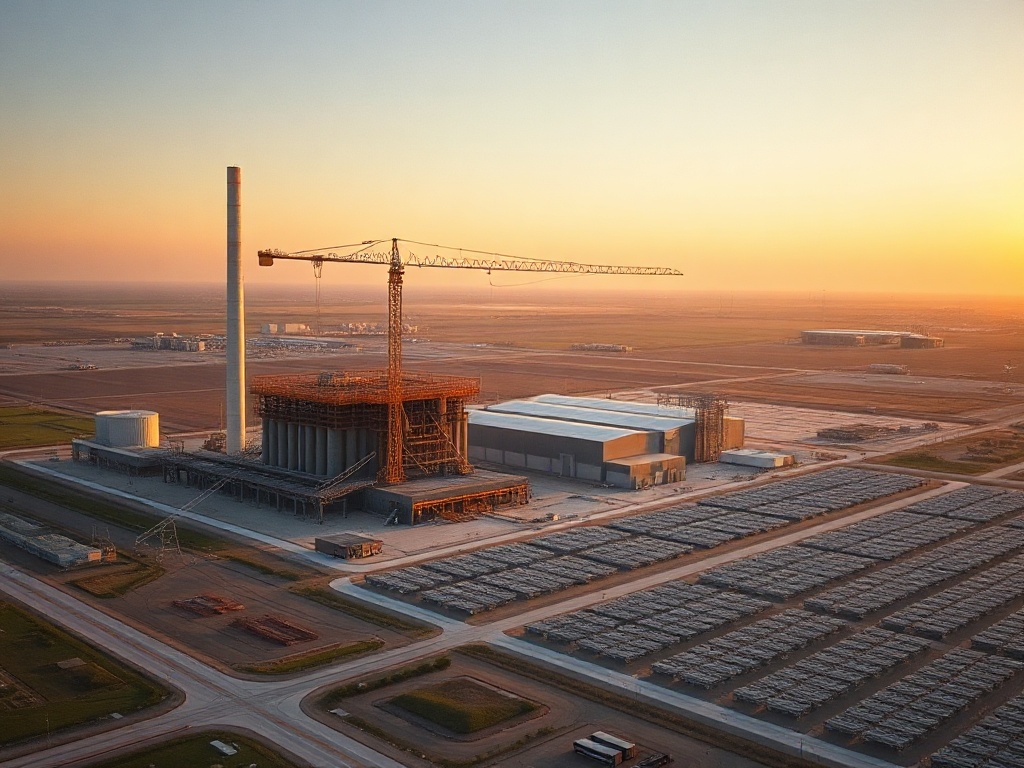
In that context, the U.S. government has announced plans to build three large-scale gas-fired thermoelectric power plants in Ohio, Pennsylvania, and Texas, with combined capacity of up to 19 gigawatts and an estimated natural gas demand of approximately 4 billion cubic feet per day operating on a continuous basis. Those figures are not marginal: they represent a significant addition to gas demand in a market that already operates with tight capacity margins.
For Exxon Mobil and Chevron, this is not merely a tailwind in the barrel price. It is the opening of an energy infrastructure investment cycle in which the large integrated companies hold structural advantages: capital, execution capacity, regulatory relationships, and above all, natural gas reserves that are now being regarded as a strategic technology asset, not merely an industrial one. The market appears to be beginning to incorporate that reclassification into valuations.
What was previously a bet on commodity prices is gradually becoming a bet on foundational technological infrastructure. That changes the risk profile of the investor entering those positions, and it also changes the type of analysis that makes sense to apply when evaluating them.
What the Market Is Really Contracting For
Behind the movements of June 1st lies a fundamental question that investors are answering with real money: within the value chain of artificial intelligence, where is the value that is hardest to replicate and most urgently needed in the short term?
The answer the market appears to give on that day is clear: not in content distribution platforms or digital advertising business models, but in the physical enablers of intensive computing. High-performance chips, specialized memory, guaranteed electricity, gas infrastructure for base-load generation. AI, viewed from the supply chain, is a manufacturing and energy industry before it is a software industry.
That has direct implications for any company making investment or positioning decisions in this environment. The most difficult barriers to entry in the next cycle are not found in writing code or developing models: they lie in securing access to electricity, obtaining grid interconnection permits, and financing computing capacity at scale. Electricity generation projects for data centers face bottlenecks in permitting, financing, and construction that no algorithm can accelerate.
The operational conclusion is more sober than the headline narrative around AI: the growth of the technology sector is being constrained by physical assets and infrastructure regulations that operate on decision cycles of 5 to 10 years, not the 18-month cycles typical of software launches. That favors those who already have those assets built, those who have the capital to finance them, and those who have the relationships to navigate regulatory processes. The large integrated oil companies, paradoxically, meet all three of those conditions better than most companies in the pure technology sector.
The market was not betting on June 1st that oil would rise or that AI would win. It was betting that the gap between computing demand and installed electrical capacity will not close anytime soon, and that whoever controls the energy controls the pace at which everything else can grow. That, more than any metric of sectoral volatility, is what deserves the attention of any executive making investment decisions over the next three years.