
Venture Capital Enters Fashion with AI and Uncovers the True Bottleneck: Governance
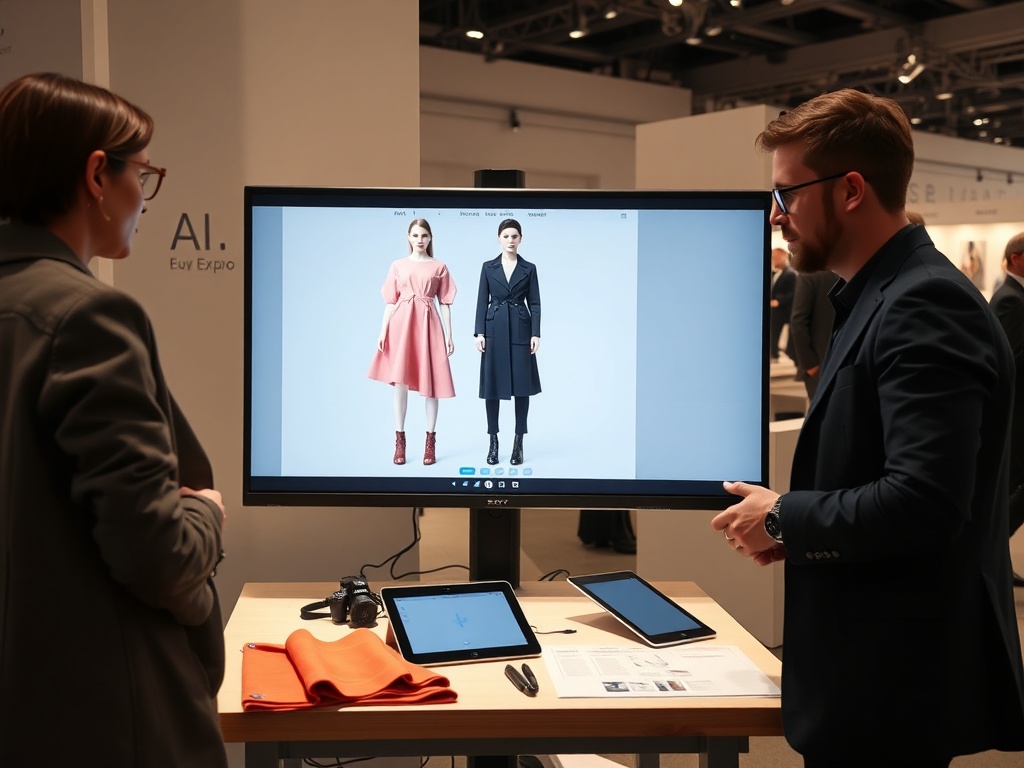
For years, fashion treated technology as an accessory. At Paris Fashion Week 2026, that logic was reversed: the Fashion AI Expo debuted within the industry's most iconic event, serving as a clear platform to integrate AI into creativity, design, forecasting, production, and sustainability. It featured showcases, live presentations, an exhibition area, and networking opportunities, with limited access and confirmed invitations. This was not just another panel; it was a signal of infrastructure.
The signal comes with numbers that explain investor appetite: the AI in fashion market projected at $3.99 billion by 2026 with an annual growth rate of over 40%. At the same time, tangible operational impacts are already being reported: generative tools and 3D workflows have reduced early sample waste by over 60%; data-driven forecasting and street style insights identify trends such as a 30% increase in tulle for 2026; and predictive production aims to eliminate up to 40% of historically unsold stock, the original sin of overproduction.
In parallel, haute couture also pushed symbolic boundaries. During the Spring/Summer 2026 Haute Couture week, Alexis Mabille presented a collection generated with AI based on his own designs, on virtual models, in front of an AI-generated fictional audience. The execution, far from being a shortcut, required a level of digital craftsmanship: fabric scanning, atelier feedback, and up to 300 iterations per look for realism.
With this backdrop, the operational thesis becomes simple: venture capital is not "discovering" fashion for its glamour, but for its potential to transform a historically intuitive business into a measurable system. The organizational thesis is more uncomfortable: as money enters and pressure for scale increases, the bottleneck shifts from the quality of the AI model to governance, the discipline of execution, and the design of teams that do not rely on heroes.
AI in Fashion is No Longer a Demo: It’s a Lever for P&L and Operational Risk
The attraction of venture capital to fashion tech is clear when AI transitions from narrative to accounting. Reducing early sample waste by over 60% is not an aesthetic improvement; it is a direct reduction of costs, time, and friction between design and production. In a sector that traditionally struggles with lengthy cycles, uncertain inventories, and margins pressured by returns and markdowns, any technology that shortens iterations and decreases wasted material reorganizes the P&L.
The second vector is inventory. The statistic of up to 40% of unsold stock that predictive production seeks to eliminate describes a structural problem, not a fine-tuning. Fashion does not suffer from a lack of creativity; it suffers from an inability to translate creativity into reliable planning. When AI promises to predict demand and adjust volumes, it delivers something that commercial committees have been trying to achieve through intuition and local experience for decades.
The third vector is cultural speed. Platforms that analyze signals in real time, exemplified by trends detected through network analysis and street observations — such as the 30% increase in tulle — convert rumor into data. Venture capitalists understand this aspect because it scales: once the signal becomes repeatable, it gets packaged in software, sold as a subscription, and defended by switching costs.
But here appears the first limit: in fashion, data does not replace judgment. It reconfigures it. In practice, AI shifts the gravitational center of the company away from individual "gut instinct" to a decision-making chain where design, merchandising, sourcing, and sustainability share a common language. The financial promise of AI is real only if the organization is prepared to operate with that interdependence.
Paris Fashion Week 2026 as a Control Panel: From Runway to System
The occurrence of the Fashion AI Expo during Paris Fashion Week is significant for both symbolism and logistics. The symbolism is obvious: technology enters the heart of ritual. The logistics are more decisive: designers, startups, innovators, investors, media, and industry coexist in a demonstration and negotiation space with limited capacity and invitation dynamics. This transforms AI in fashion into a business conversation, not a marginal experiment.
The available facts describe an operational regime change during the week: digitized backstages, cycles compressed from traditional horizons to days through generative tools, virtual fittings, and fitting simulation on digital twins, and even more automated forms of commerce with AI stylists capable of executing purchases based on user queries. Fashion ceases to be a linear sequence — inspiration, design, prototype, production, retail — and begins to operate as a closed data loop.
Mabille’s case provides a lesson that the tech industry often overlooks: realism comes at a cost. The 300 iterations per look, fabric scanning, and atelier feedback prove that value does not lie in pushing a button but in creating a workflow where the digital respects materiality. For the investor, this redefines where the competitive advantage resides: not in the final image, but in the process, in integration with the atelier, with pattern making, with sourcing, and with quality standards.
It also redefines the type of startup that can succeed. If the product is merely a beautiful interface, it becomes replaceable. If the product is embedded in the decision-making system — design, purchasing, planning, sustainability — it becomes infrastructure. The Expo, by design, pushes towards that reading: less spectacle, more adoption.
The Myth of the Visionary Founder Does Not Scale in Fashion Tech: The Winning Team “Severs” from Operations
When venture capital enters, the narrative often seeks a face. In fashion tech, that temptation is especially strong because the industry is already trained to idolize creatives and artistic directors. The risk is to transfer that logic to software: confusing a charismatic story with an operable company.
Here, the pattern I observe repeatedly in companies trying to industrialize creative innovation is clear: the product advances faster than the organization. Brilliant demos are constructed, pilots are established, press coverage is generated. But the internal system still depends on one or two individuals to translate everything: the vision, the client, the roadmap, the prioritization, even the culture. This works in the exploratory phase; it breaks down when multiple brands, geographies, regulatory constraints, and auditable sustainability expectations arrive.
The Fashion AI Expo, while not announcing specific deals, functions similarly as a thermometer of maturity: the networking space is not for admiring technology; it is for negotiating integration, data, processes, and contracts. In that realm, the star founder serves to open doors, but not to sustain quarterly deliveries.
Also, in fashion, the cost of reputational error is high. A poorly implemented demand prediction is not a bug; it is dead inventory. A deficient fitting simulation is not “beta”; it results in returns, customer frustration, and trust loss. Therefore, the company that scales is not the one with the most visible CEO, but the one possessing product governance, clear ownership of decisions, and teams capable of operating without asking for permission every day.
The most honest indicator of management quality in this sector is whether the company can absorb complexity without turning it into internal drama. This requires leaders with relentless professional will and practical humility to build processes, not cults of personality. In other words: the valuable company is the one that makes its central figure dispensable in everyday operations.
What Venture Capital Is Really Buying: Waste Reduction, Predictability, and Control
The headline “venture capital discovers fashion tech” sounds like a passing fad. The numbers and use cases describe something different: a quest for control in a historically unstable sector. Waste reduction in sampling, the promise of trimming unsold inventory, and real-time trend forecasting are three parts of the same ambition: to convert uncertainty into a manageable range.
This has direct implications for how these startups should be built.
First, the business model must be anchored in metrics that the client can defend internally. If savings in sampling exceed 60%, the argument is not “innovation”; it is efficiency with environmental impact. If predictive production targets 40% of unsold stock, the argument is not “AI”; it is released working capital and decreased reliance on markdowns.
Second, the financial architecture benefits when software transforms fixed costs into variable ones. Fashion exists under tension between installed capacity, rigid schedules, and supplier commitments. AI and 3D simulation promise flexibility, but only if they integrate into approval flows and do not remain an experimental island.
Third, execution risk exceeds technical risk. There are no data in the sources about rounds, investor names, or closed deals at the Expo, and this absence is instructive: enthusiasm exists, but serious capital pays for sustained adoption, not headlines. In fashion tech, sustained adoption is earned through implementation: training, process redesign, alignment between areas, and a decision system that does not rely on improvisation.
The result is a change in criteria for capital and for C-level roles in fashion: less fascination with the demo and more scrutiny over the structure that turns it into results. AI stays in the industry not for what it generates, but for what it eliminates: waste, excess stock, and decision latency.
Executive Maturity as Competitive Advantage in the New Fashion Infrastructure
The Fashion AI Expo at Paris Fashion Week 2026 and the visible adoption of AI on runways and backstages mark a point of no return. The industry is building an operational layer where creativity and data coexist, reshuffling who wins: not necessarily the most creative, but the most consistent.
In this scenario, executive maturity ceases to be “culture” in a soft sense and becomes hard competitive advantage. A team that defines decision responsibilities, documents criteria, measures impact, and delegates autonomously can integrate tools like 3D simulation, social forecasting, and predictive production without falling into cycles of constant urgency. A team that relies on the founder for every pivot turns a market opportunity into operational fragility.
Fashion is particularly sensitive to the temptation of a savior: the genius designer, the visionary creative director, the charismatic CEO who “feels” the market. AI, paradoxically, amplifies that risk if sold as magic in the hands of a single person. Real implementation demonstrates the opposite: even a virtual haute couture collection requires layers of work, feedback, standards, and quality control.
Venture capital can fund technology, but it cannot replace the human architecture that makes it useful. The company that capitalizes on this wave is the one that turns AI into process, and process into discipline, and discipline into an organization capable of operating with real horizontality. True corporate success is only achieved when leaders build a system so resilient, horizontal, and autonomous that the organization can scale into the future without ever depending on the ego or indispensable presence of its creator.