
The Insider Signal at KKR: It’s Not “Confidence,” It’s a Revenue Machine Shift
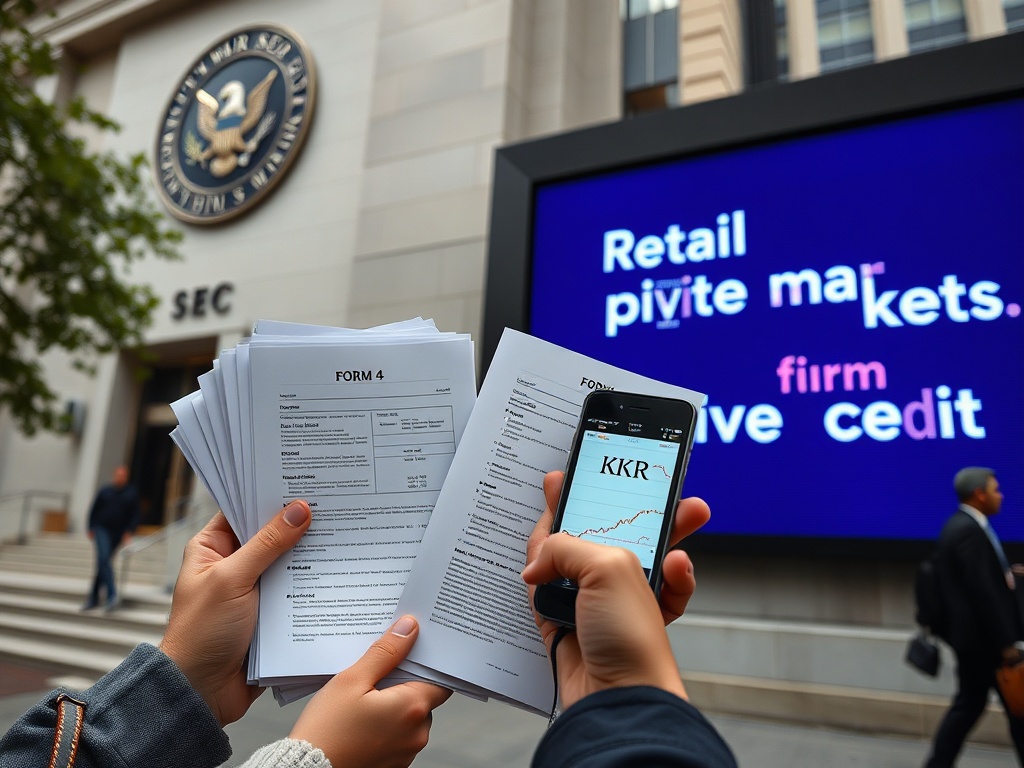
KKR has sent a rare signal in terms of size and timing: insider purchases totaling approximately $46 million since February 2026, according to SEC Form 4 filings. During this same period, the firm has accelerated its messaging and movements that point to a clear operational thesis: to reduce dependence on the typical “exit cycle” of private equity and push for a more stable revenue architecture based on long-duration capital, retail channels, and private credit.
The key detail is not just the amount. It’s the context: these purchases ramped up after an 18% decline from January 2026 highs, following disappointing results in the Q4 2025 and sector volatility among alternative managers. In this context, co-CEO Scott Nuttall described the market sell-off as “an overreaction and a buying opportunity,” linking the portfolio's resilience to limited exposure: only 7% of AUM in software vulnerable to AI, lower than the industry average, according to coverage.
What’s relevant for leadership isn’t whether the price will “bounce back.” It’s understanding why an organization like KKR is seeking to redesign its revenue machine when the market is becoming more demanding.
Insider Buying Matters When It Aligns with Major Revenue Profile Changes
Some insiders buy to “support” a narrative. Others buy when the company is moving pieces that alter the income and risk profile. In KKR, the latter fits best with the reported facts.
The details are concrete: a director, Timothy R. Barakett, purchased 50,000 shares on March 4, 2026, at a weighted average price of $94.47, totaling $4,723,500. Another director, Mary N. Dillon, acquired 22,225 shares on March 2, 2026, at $90.96. Most notably, co-CEOs Scott Nuttall and Joseph Y. Bae each bought around $12.8 million in stock on February 17, 2026, within a block of four insiders who bought over $35 million in ten days.
This cadence suggests coordination with the internal business reading, not a standalone gesture. A consistency point also emerges: over the last 24 months, insiders have bought 14,876,133 shares for $246.48 million, with notable activity from vehicles linked to the firm (KKR Alternative Assets LLC and KKR Group Partnership L.P.). This history doesn’t guarantee price direction but reinforces that the organization has been maintaining a pattern of ownership alignment.
From a leadership perspective, this is an uncomfortable reminder: when the market punishes, the typical defensive response is to cut ambition or “wait for better windows.” KKR is doing the opposite: buying shares and accelerating a strategic pivot. That only makes sense if they internally believe the firm is changing the type of earnings it can produce and the predictability with which it can produce them.
KKR’s Bet: Shifting from “Exits” to Permanent Capital and Retail Distribution
The shift toward retail isn’t a minor commercial detail; it’s a fundamental business model engineering move. Alternative managers earn from management fees, performance fees, and, in favorable cycles, from crystallizing profits via sales or IPOs. When the environment slows down exits, the most volatile part of income becomes exposed.
In this context, KKR's agreement with Capital Group, which manages $3.1 trillion, aims to broaden retail access to private markets through K-series funds. Reports mention that the K-series already has $34 billion in assets, distributed via financial advisors, banks, and broker-dealers, with more accessible conditions: no accreditation requirement and minimums of $1,000 for most share classes.
Operationally, this reconfigures the funnel. Retail not only brings volume: it also offers persistence, provided the product is understandable, risks are well-packaged, and the distribution experience is well-managed. For a firm like KKR, the institutional channel may be large but more concentrated; the retail channel may be more fragmented but has greater inertia if built correctly.
As an Editorial Director and scalability analyst, I view this move as a change of “muscle”: shifting from relying on a few institutional allocation decisions to building a distribution network that can continue capturing capital even as the M&A cycle cools. It’s not magic: it requires product, compliance, reporting, and a rigorous expectation discipline. But if it works, it tends to stabilize commission incomes.
The leadership here lies in accepting the cost of complexity today to buy stability tomorrow. In practice, KKR is trying to turn part of its growth into a business more resembling large-scale wealth management, without abandoning its alternative DNA.
Private Credit and CLOs: The Art of Converting Macro Volatility into Margin
The second pillar of the shift is credit. Coverage mentions a key piece of information: KKR has $118 billion of dry powder for lending. That number, in a high-rate environment with accumulating maturities, signifies the ability to negotiate spreads, covenants, and structure.
In this direction, KKR launched KKR-KIMM CLO 2 LLC on March 6, 2026: a collateralized loan obligation (CLO) backed by senior-secured loans to speculative-grade middle-market companies. The note highlights the typical contrast of the instrument: senior tranches rated AAA by S&P Global Ratings, even though the underlying collateral is rated BB+ or lower.
Here, the discussion isn’t technical-financial for sport. For leadership, the point is what kind of organization is needed to operate this business without self-deception. Private credit grows when banks withdraw, but its “cost” is the management of risk in a part of the market where missteps are paid for with years of drag.
The coverage also underlines a structural risk: a wall of $1 trillion in leveraged loan maturities in the coming years. In that scenario, a lender with liquidity can gain share and margin through refinancing, but can also absorb deterioration if they underestimate the ability to repay at higher rates.
What KKR seems to be doing is positioning itself to capture the “inevitable” side of the cycle: companies that need refinancing. If underwriting is sound, the spread becomes recurring income; if it isn’t, it turns into losses and headlines. Leading in credit means maintaining discipline when the market pays for placing money quickly.
“AI-Proof Assets” and the Trap of Confusing Narrative with Exposure
KKR introduced an angle that many managers are starting to exploit: “AI-proof assets.” In the earnings call, Nuttall stated that only 7% of AUM is exposed to software vulnerable to AI and that they proactively reduced that exposure.
This has two interpretations.
The first is prudent: if the firm believes certain software categories may face competitive or pricing pressure from AI, reducing exposure can decrease valuation volatility and protect returns. As a market signal, it also helps to differentiate within a sector where many portfolios are laden with technology.
The second is operational: “AI-resistant” is not a permanent attribute; it’s a snapshot of risk today. Real resilience is measured in cash flows, contracts, physical necessity, and pricing power. Infrastructure linked to data centers, energy, or physical assets may be less sensitive to model disruptions, but it’s not free from cycle, regulation, or capital cost risks.
From my perspective, what’s relevant is that KKR is attempting to reduce its reliance on assets where disruption can quickly compress margins. Nonetheless, serious leadership avoids turning that narrative into internal sloganeering. If the thesis is “less vulnerable software,” the control mechanism must be explicit: exposure limits, assumption reviews, and a committee that understands both technology and finance. Without that, the concept turns into marketing.
The emerging pattern is clear: KKR is managing its portfolio as if the cost of being wrong has increased. That’s a rational reaction to higher rates, lower exit liquidity, and technological changes.
The Lesson for Leaders: Redesign the Source of Stability Before the Market Demands It
The most interesting aspect of the KKR case isn’t the stock purchases per se. It’s the synchrony between internal signaling and model redesign: retail to expand distribution, credit to monetize refinancing, and a limited tech exposure narrative to reduce uncertainty.
For CEOs and CFOs outside finance, the parallel is direct: when the environment becomes more costly and less predictable, the companies that fare better are not the ones that “cut” first; they are those that convert cyclical dependence into recurring income. In KKR, permanent capital and the retail channel aim for that. Private credit aims to capture margin where there’s structural need. Reducing exposure to vulnerable software aims to contain volatility.
This type of change demands clear governance. A shift toward retail introduces reputational sensitivity and an obligation for consistent customer experience. A shift toward credit requires a risk culture and patience to restructure when necessary. And a narrative of “AI-proof” demands internal metrics to avoid turning it into faith.
The insider buying of $46 million serves as an indicator that, behind closed doors, the firm believes this revenue machine is defensible. In leadership, the actionable takeaway is to watch whether the distribution and risk architecture supports the narrative with measurable execution.