
Sprint in Birmingham: A Bold Investment in Bus Lanes that Only Works if Managed as a Product
The toughest change in urban mobility is not about buying electric buses or unveiling new shelters. It’s about reallocating space from cars and upholding that choice when queues, headlines, and political friction arise. This is exactly what Birmingham is navigating with Sprint: a continuous bus priority corridor along the A34 and A45, designed to connect Walsall with Birmingham city center, Solihull, Birmingham Airport, Alexander Stadium, and the NEC.
The facts, as reported: Phase 1 was delivered on time and within budget before the 2022 Commonwealth Games, incorporating 9.3 kilometers of new bus lanes, improvements at over 50 traffic signal crossings, 40 pedestrian crossings, and more than 100 accessible stops. The operational impact is noteworthy: a 22% reduction in peak travel times supported by vehicle detection and traffic signal priority developed with Transport for West Midlands (TfWM), National Express, and local authorities. Now, Phase 2 expands the corridor with further priority, shelters, lanes, and construction; in Birmingham and Solihull, work began in September 2024, with major construction in Walsall expected to commence in early 2026.
Thus far, it’s the typical infrastructure story. The strategic angle, however, is different: Sprint is no longer just a construction project; it’s a service system promising reliability. And that promise, once made, demands management as a product, not a project.
The Investment is Clear; The Real Risk Lies in the Last Mile of Operations
The investment package shows ambition and, importantly, a logical sequence: first, build priority (lanes, signals, stops), then reinforce the service capacity. The West Midlands Investment Board approved the purchase of 24 electric “tram-style” buses, with multiple doors for quicker boarding, for £26 million, including fleet and charging infrastructure, plus £5.5 million for ticketing equipment. Simultaneously, construction contracts are up: £5 million for work on the A34 (Packages B and C) and an £11 million scheme on the A45 between Moor Street Queensway and Yardley, with widening, resurfacing, upgrade of crossings, sidewalks, signage, and landscaping.
In a startup, when hardware and infrastructure start dominating the conversation, it usually signals danger: there’s a confusion of “capacity to build” with “capacity to deliver sustained value.” Here the risk is similar, though the context is public: the critical variable isn’t the CAPEX, it’s the daily operation and actual adoption.
Sprint already has a strong technical argument: traffic signal priority and dedicated lanes can restore predictability to a congested corridor. But the system collapses if any of these components fail: lane control discipline, enforcement, maintained signal coordination, operator regularity, incident management, and a stop-and-payment experience that reduces friction during peaks. The key takeaway is that the design of the buses themselves—multiple doors—acknowledges that the bottleneck is not only on the road; it’s also in stop times.
If this initiative is managed as just “completing the construction,” the region ends up with a beautiful corridor and a narrative of modernization. If managed as “reducing peak travel minutes from end to end, every day,” then Sprint becomes productivity infrastructure, which is the only type that justifies the expenditure.
The A45 Pilot Was the Right Move, But It Cannot Be a Footnote
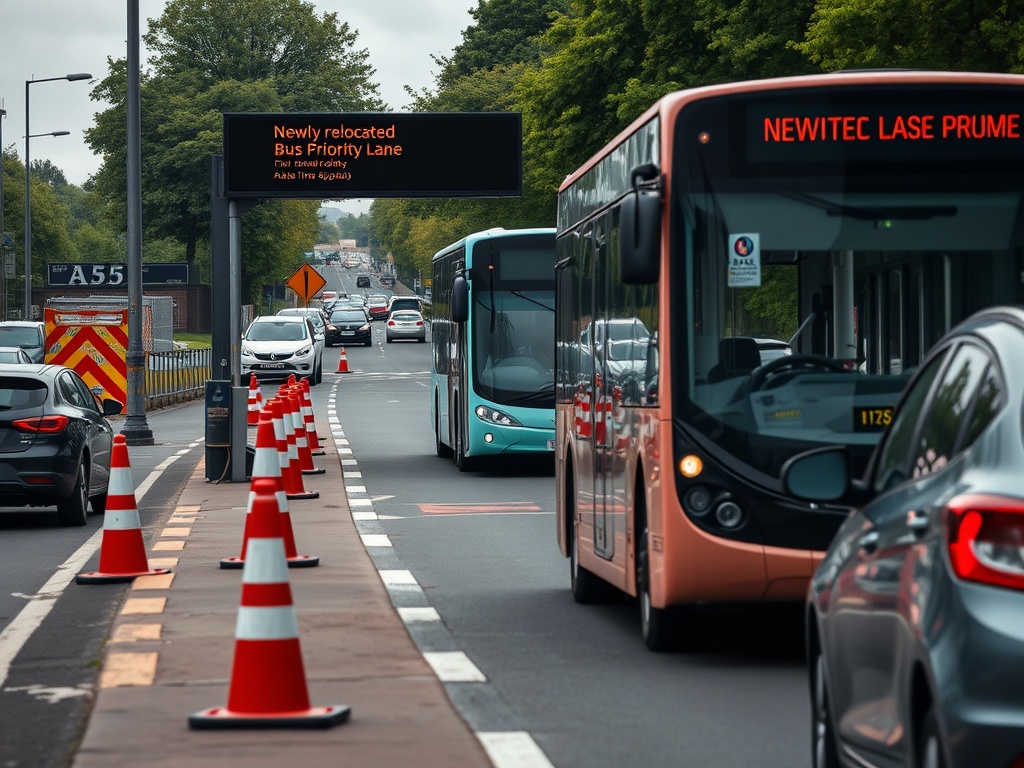
The closest thing to an experimental mindset throughout the narrative is the lane reallocation pilot on Coventry Road (A45) from May 7 to May 20, 2024, with barriers, cones, and signage, accompanied by surveys and measurements of traffic counts, queues, and travel times. This type of trial does two important things: it reduces the risk of blind design and forces discussions based on data, not intuition.
The problem is that many public programs treat the pilot as a consultation requirement, not as a decision-making mechanism. A minimal experiment in mobility holds value only if it leads to subsequent decisions: what is maintained, what is reverted, what is adjusted, and using what thresholds. The complete corridor is 20 kilometers, and the variability of the route is huge: sections with street-side commerce, high-speed segments, residential areas, access to the center, and critical nodes such as the airport or the NEC. A two-week pilot is a useful start, but it is too short if it does not become a repeatable measurement cycle.
Phase 2 also adds an inevitable element: disruption due to construction. Restrictions are in place on the A45 with lane closures between Lyndon Road and Gilbertstone Avenue, and overnight resurfacing work on Gilbertstone Avenue is expected for November 2025. The invisible economic cost of these programs is often paid in lost trust: businesses affected by accessibility, frustrated drivers, bus users who do not see immediate improvements.
Here, the product discipline is simple yet brutal: during construction, the “product” is communication and impact management; after construction, the “product” is punctuality. And neither can be won with renderings.
Governance Defines Performance: Too Many Owners, One User
Sprint is not a company; it is a coalition. TfWM leads, there are multiple involved councils, operators like National Express, engineering and construction providers, and a regional political framework. In these architectures, failure is rarely technical. The typical failure is of interface: vague responsibilities, misaligned incentives, and metrics that lack a shared definition.
When the regional mayor proclaims that the service will be “the first continuous cross-route in decades” and will cut travel times between Walsall, Birmingham, and Solihull, they are placing a market promise atop a complex governance system. That promise is good; it’s also dangerous if it doesn’t translate into an operational contract between stakeholders.
In such projects, the bureaucratic temptation is to measure what is easy to audit: kilometers of lanes, number of stops, number of updated traffic signals. All that is input data. The user buys output: minutes, regularity, and a feeling of control.
Phase 1 reported a 22% improvement during peak hours due to smart detection and priority. That figure is gold, as it defines a measurable north star. The next logical step, to avoid falling into the “infrastructure as an end” trap, is to convert that metric into a dashboard that governs the operation: door-to-door time by time slot, variability of travel time, adherence to frequencies, boarding times at key stops, and correlation with incidents and events (NEC, airport, stadium). If each actor optimizes their own KPI, the corridor fragments even if the lane painting is continuous.
Moreover, there’s a power dimension: reallocating lanes touches interests. The pilot with cones was a controlled version of that conflict. Phase 2 and the expansion to Walsall in 2026 will amplify it. The only sustainable way to maintain bus priority is to demonstrate, repeatedly, that the system delivers net value, not just for bus users but for the economic functioning of the city.
The “Tram-style” Bus is an Experience Bet, Not a Marketing Gimmick
The most enticing headline is the purchase of electric “tram-style” buses. It’s easy for this to become merely aesthetic: new vehicles, multiple doors, shelters with CCTV, real-time information, and more space. All of that matters, but only as long as it reduces friction and increases effective capacity.
The operational logic behind “multiple doors for faster boarding” is solid: if the goal is to cut minutes, the time spent at stops is just as relevant as time in transit. In a corridor with signal priority, the next bottleneck is passenger exchange. Tram-style design makes sense when accompanied by ticketing that does not turn each stop into a slow cash register.
Thus, it’s significant to allocate £5.5 million for ticketing equipment. It’s not an administrative detail; it’s integral to performance. A corridor with dedicated lanes and smart signals can lose its advantage if boarding is managed as an antiquated process.
The execution risk, however, is clear: you buy the fleet and charging infrastructure, but users won’t notice the leap if the service remains erratic or if the construction prolongs the pain. In mobility, users forgive an old vehicle if it arrives when promised; they punish a new vehicle if the timing promise fails.
The strategic opportunity is that Sprint can become a replicable BRT standard in the UK, primarily because it seeks tram-like efficiency at a lower cost. But the standard is not set by the brochure; it’s defined by the repeatability of time and reliability improvements, month after month.
The Executive Discipline that Separates a Useful Corridor from a Public Works Monument
The story of Sprint began in 2018, pushed to be ready before 2022, suffers delays due to COVID and costs, yet manages to deliver Phase 1 with measurable improvements and is now entering Phase 2, which will be politically tougher due to the construction duration and accumulated expectations. That timeframe is sufficient to observe the pattern: infrastructure changes, but the environment changes even faster.
At this point, the smartest move is to treat the corridor as a product with versions. The “version” is not the asphalt; it’s the level of service. When a segment goes under construction, a degraded version is published with clear mitigations. When signal priority or a new lane is activated, an improved version is issued with verifiable metrics. The public promise ceases to be vague and transforms into a performance contract.
The public note already includes elements of this approach: temporary trials, queue and time measurements, and an explicit claim of time reductions. The leap in maturity is to tie all that to a habit: iterating with data, not grand openings.
True business and public growth occurs when the illusion of the perfect plan is abandoned in favor of constant validation with the real customer.