
The New Market Emerges from an Uncomfortable Equation
Iran has transformed the Shahed drone into a weapon of attrition: thousands of units launched in waves can saturate traditional defenses and force armies to expend costly ammunition to take down relatively inexpensive targets. This reaction is opening a market that, in terms of ticket size and adoption speed, resembles less the classic missile industry and more a fast hardware segment with weekly iterations and tight supply chains.Available data highlights the financial reordering underway. A PAC-3 interceptor missile from the Patriot system can cost around $4 million per missile, while several manufacturers of interceptor drones are discussing units priced between $1,000 and $15,000. The Shahed-136 itself is estimated at ranges of $20,000 to $50,000, or even $50,000 to $100,000 according to other evaluations. The arithmetic is compelling: if the attacker can launch in volume while the defender responds with premium ammunition, the defense suffers from financial exhaustion even when tactically successful.
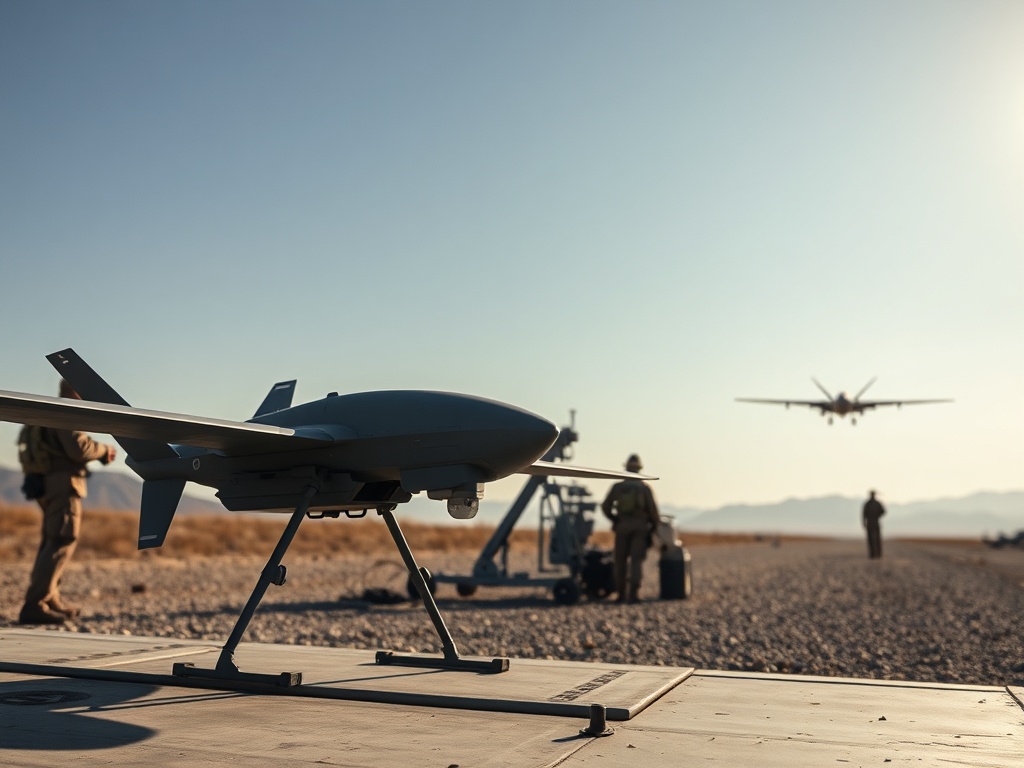
In this context, the United States is preparing to deploy the Merops system, which includes the Surveyor interceptor drone priced at approximately $15,000 per unit, boasting a record of over 1,000 interceptions of Shahed-type drones in Ukraine, according to defense officials cited by Business Insider. The operational promise also matters: a capability that can be deployed in about a week following the announcement on March 7, 2026, and can be combat-ready in days, operated by a four-person team.
For its part, Ukraine has inadvertently created a scalable air defense "laboratory". SkyFall manufactures the P1-SUN, which, within four months, has reportedly shot down more than 1,500 Shaheds and 1,000 additional drones; its cost to the Ukrainian military is around $1,000 per unit, with export prices likely higher. By February 2026, interceptors accounted for 70% of the downed drones in and around Kyiv. This represents a structural shift: drone-versus-drone has ceased to be an experiment and has become the backbone of air defense.
Defense Startups and the Product No Longer Sold with Narrative
This surge is not about "more demand for drones". It’s about the demand for a complete system: sensors, interceptors, training, logistics, replenishment, and adaptation to evolving threats. In a reference note, SkyFall claims the capacity to produce up to 50,000 interceptors per month and estimates it could export 5,000 to 10,000 without affecting domestic needs, provided the government approves it. That figure alone characterizes a company thinking like a scalable manufacturer rather than a heroic workshop.Simultaneously, the Merops system is presented as a portable package, operable by a small team, with performance evidence transferable from the Ukrainian front to the Middle East. The catalyst is the escalating attacks with Shaheds against U.S. allies in the region following the start of Operation Epic Fury on February 28, 2026, according to Business Insider. The market is responding urgently, and urgency rewards what is already proven.
This is where the myth of the charismatic CEO becomes a business risk. In defense, purchases do not close based on charisma; they close based on traceability: interception rates, tolerance to interference, production cadence, training time, and the ability to maintain availability as the environment degrades. SkyFall even mentions a three-week academy for pilots, because the bottleneck isn’t just manufacturing; it’s training operators and sustaining them. A founder who centralizes decisions for public image becomes friction: delaying certifications, blocking support agreements, and weakening relations with governments.
What I see clearly is that these companies are moving towards a logic of "repeatable product" more akin to the industrialization of hardware than the epic of entrepreneurship. The hero does not scale a production line of tens of thousands monthly nor standardize cross-border training. That is the work of a team architecture: operations, quality, supply chain, compliance, and a commercial front that understands government purchasing.
Unit Economics Impose Governance and Operational Discipline
Cost comparison is not mere rhetorical flourish: it is the driver of a doctrinal shift. If a Shahed costs tens of thousands and the downing with Patriot costs millions, defense becomes an issue of ammunition allocation and inventories. Business Insider notes that Lockheed Martin produced a record 600 PAC-3 MSE in 2025, suggesting capacity limits even in established industries. In that framework, the inexpensive interceptor not only saves money; it buys time and reduces dependence on a scarce inventory.But cost-per-unit alone isn't sufficient. There is an invisible cost that determines which startups survive once demand peaks: field failures, replenishment, and learning rates per iteration. The Surveyor is described as having a speed exceeding 175 mph, compared to the 115 mph of the Shahed-136, although faster jet variants exist. That performance advantage matters, but even more important is the discipline to capture telemetry, translate it into design changes, and deploy updates without disrupting production.
This kind of market punishes organizations that confuse "innovation" with merely showcasing prototypes. The evidence from Ukraine is brutally practical: counted downings, operation periods measured in months, and constant pressure from interference and saturation. SkyFall describes models with AI-assisted navigation capable of operating in jammed environments. There’s no need for embellishment: if the electronics fail or the link breaks, the product ceases to exist.
The consequence for the C-Level of any defense startup is uncomfortable: competitive advantage is no longer a brilliant idea or a demo. It is the capacity to produce and learn without depending on personal decisions. That’s the point where governance becomes product. When a system is deployed "in a week" and ready "in days," as claimed for the Merops, the organization behind it must operate like a machine: permissions, parts, manuals, instructors, maintenance, and an incident circuit that does not wait for the founder.
Exporting Sensitive Technology Requires an Unbroken Organization
The boom has an obvious temptation: selling to everyone who inquires. The reality is more restrictive. SkyFall indicates a willingness to export if the government approves and prioritizes domestic defense; there are also mentions that Ukraine maintains restrictions. In the same bundle of facts, a strategically high-value element appears: Zelenskyy stated that Ukraine received a direct request from the U.S. for assistance against Shaheds and that it would provide "necessary means" with specialists. This isn’t just commerce; it’s applied diplomacy.When a startup enters this zone, the operation changes in nature. Exporting interceptors is not sending boxes. It is managing approvals, end-use clauses, training, support, and, in some cases, instructor presence. It is also managing reputation under conditions where a failure becomes news and affects future sales. The pressure of demand from the Middle East, described as a "flood" of inquiries, could break the company if its internal culture is built around a small core that decides everything.
Here lies the risk of overcapacity if the conflict de-escalates. The history mentions that on March 7, 2026, President Donald Trump announced that Iran had "apologized and surrendered" to its Middle Eastern neighbors, promising not to attack U.S. allies further while threatening to escalate U.S. actions. That statement, regardless of its trajectory, illustrates market volatility: a political shift can cool purchases, delay contracts, or alter priorities.
The mature company does not respond with more heroics; it responds with structure. It converts fixed costs into variables when possible, avoids single-client or operational theater dependency, and designs a product line that doesn’t become obsolete if the adversary’s profile changes—for example, with faster or quieter variants like the Shahed-101 electric mentioned in context. Resilience does not come from the founder; it comes from contracts, internal capabilities, and a distributed decision-making chain.
A Sustainable Advantage is a Team That Can Fire the Founder from Operations
This market rewards what many startups postpone: professionalization without stifling speed. An interceptor costing between $1,000 and $15,000 that avoids the cost of a $4 million missile only creates value if the organization can guarantee supply, training, maintenance, and continuous improvement under stress. The phrase "combat proven" is an asset only when processes support it.I see two possible paths for small manufacturers currently receiving calls from the Middle East and the United States. The first is the media route: a CEO turned into a permanent spokesperson, absorbing decisions, building internal dependency, and selling a narrative. This route tends to work while the market is euphoric and demand exceeds supply; it breaks when audits arrive, compliance demands arise, operational incidents occur, or geopolitical changes take place.
The second path is less glamorous and more profitable: separating leadership from operations, building middle management with real authority, documenting field learnings, and turning them into frictionless industrial iterations. This is the path that enables producing twice what’s needed for the domestic market, as the CEO of the UCDI association stated about Ukrainian capacity, while still sustaining exports without degrading domestic defense.
Corporate success in this cycle of interceptor drones belongs to the C-Level that builds a resilient, horizontal, and autonomous organization capable of scaling into the future without ever relying on the ego or indispensable presence of its creator.