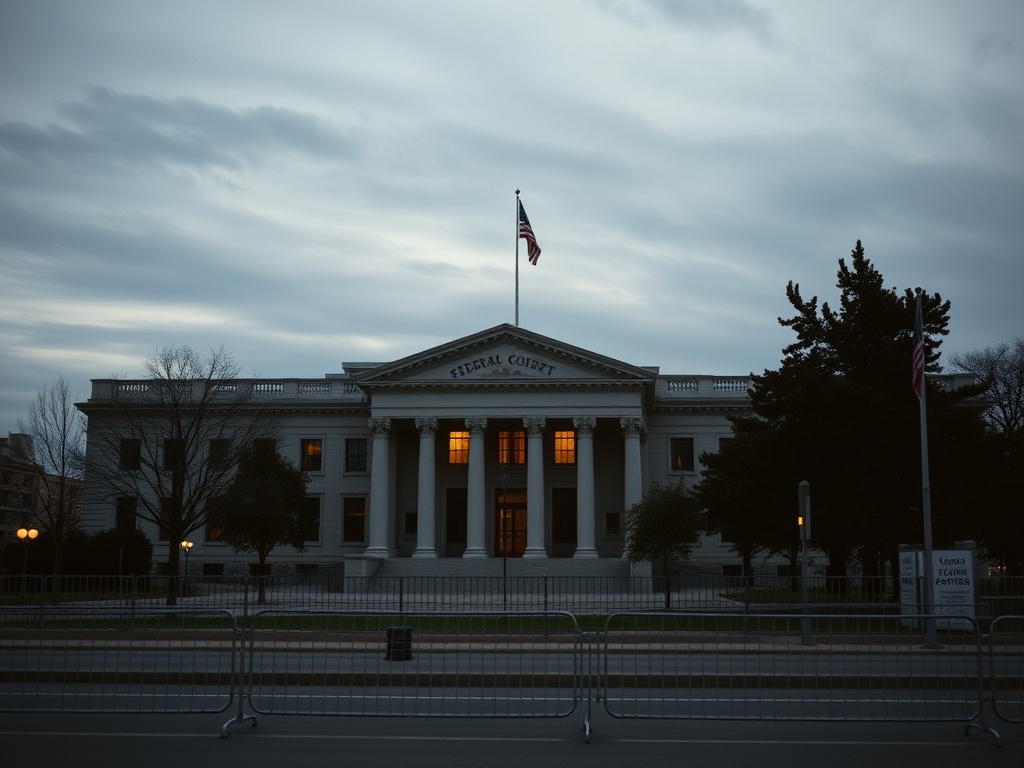

The Ruling that Split U.S. Justice in Two
On April 8, 2026, the D.C. Circuit Court of Appeals rejected Anthropic's emergency request to temporarily suspend its designation as a supply chain risk by the Department of Defense (DoD). The decision was concise but surgical: the court acknowledged that Anthropic would suffer "some degree of irreparable harm" but ruled that the harm was "mainly financial" and that the balance weighed in favor of the government during an active military conflict.
What makes this situation particularly complex is the existence of a parallel ruling going in the opposite direction. A federal judge in San Francisco had previously granted a preliminary injunction that forced the Trump administration to lift the risk labels, allowing federal agencies other than the Pentagon to continue using Claude. Two courts, two opposing interpretations of the same conflict. Anthropic can continue selling its model to nearly all federal government entities, but it has the door to the Pentagon firmly locked while the litigation heads toward a scheduled hearing on May 19, 2026.
When the Product that Sets You Apart Closes a Door
Here lies the strategic knot that conventional analyses of this case are overlooking.
Anthropic built its business identity on a specific premise: creating artificial intelligence systems with integrated safety controls. That’s why Claude exists as a distinct product, why the company attracts talent different from OpenAI or Google DeepMind, and why certain corporate clients prefer it. The safeguards are not an accessory; they are the architecture of the product.
The problem is that the Department of Defense did not hire Anthropic to buy its philosophy on safe AI. It hired, or attempted to hire, a specific operational capability for military contexts. From that perspective, the safeguards that Anthropic considers the core of its value proposition are, for the Pentagon, a functional obstacle. The “job” that the client wanted Claude to perform required precisely the absence of some of those controls.
This places Anthropic in a position that few startups face so clearly: its central differentiator is incompatible with the requirements of its largest potential client. It’s not a pricing issue, a technical performance issue, or a corporate reputation issue. It's a design incompatibility that no commercial negotiation can resolve without one party abandoning its foundational position.
The practical consequences are not minor. Defense contractors now operate under two sets of policies: they can use Claude for projects unrelated to the Department of Defense but must exclude it from any work linked to the Pentagon. This creates operational silos that complicate tool management, increase internal training costs, and generate friction in organizations working simultaneously on civilian and military contracts.
The Geometry of Financial Harm and What the Court Misjudged
The D.C. Circuit Court dismissed Anthropic’s damage, labeling it as "mainly financial." This characterization merits a cooler analysis.
When a federal court designates a company as a risk in the defense supply chain, the impact is not limited to lost contracts with the Pentagon. The label contaminates the perception of risk in adjacent sectors: intelligence agencies, contractors with dual contracts, international partners of the U.S. government, and potentially private sector companies that prioritize not having suppliers with active litigation against the federal government. The reputational damage from such a designation operates differently than direct damage from canceled contracts, and it is significantly harder to quantify or reverse with a press release.
Anthropic achieved a partial victory with the San Francisco injunction, which forced the government to lift the risk labels for non-defense-related agencies. This contains the contagion. However, the D.C. court kept the Pentagon's designation active, meaning the reputational risk persists in the defense sector for several additional months while competitors negotiate contracts that Anthropic cannot touch.
OpenAI's and Google’s positions in this scenario are objectively more comfortable. Without the restriction of integrated safeguards that Anthropic refuses to disengage, both companies have greater flexibility to adapt their models to the operational requirements of the Department of Defense. Excluding Anthropic is not just a short-term loss of revenue; it represents a window of six to twelve months during which competitors can consolidate contractual relationships with the Pentagon that will be difficult to displace once the litigation concludes, regardless of the judicial outcome.
What This Case Says to Any Tech Company Working with Governments
The emerging pattern here is not exclusive to artificial intelligence or Anthropic. It is the 2026 version of a tension we already saw with encryption companies in the 1990s, drone manufacturers in the last decade, and communication platforms in recent conflicts: governments, particularly in national security contexts, do not buy technology to adapt to it. They buy technology expecting it to adapt to their operational doctrines.
Anthropic's strategy of maintaining its safeguards is consistent with its identity and, from a long-term perspective, may be the right one. Yielding on that point would have eroded the credibility it built with corporate clients who value precisely those controls. But that decision comes at a cost that the market can now measure precisely: at least six months of exclusion from the world’s largest institutional buyer of technology, with a hearing in May that will determine whether that exclusion extends indefinitely.
Anthropic's long-term success in the public sector will depend on whether it can demonstrate that there is a segment of the federal government willing to hire artificial intelligence under the conditions the company imposes, and whether that segment is large enough to sustain its business model without the Pentagon. The San Francisco injunction suggests that such a segment exists. What the D.C. decision confirms is that the defense segment, the most capitalized of all, is not part of it under current conditions.
The work that the Pentagon was trying to contract was not an advanced language model. It was an unrestricted operational capability, and Anthropic refused to sell it. That refusal was a product decision disguised as litigation.