
Oil No Longer Guarantees Dollar Dominance
For decades, the most honest answer to why the dollar remains the global reserve currency was neither ideological nor technical: it was operational. Deutsche Bank articulated it with surgical precision: "The world saves in dollars largely because it pays in dollars." And what the world pays for in dollars, primarily, is oil.
This causal chain—oil production, billing in dollars, accumulation of reserves, sustained demand for U.S. debt—is what economists refer to as the petrodollar system. It is not a formal treaty or an institution based in Washington. It is a self-reinforcing incentive mechanism that has persisted for 50 years because it benefited enough actors simultaneously. Gulf producers sold in dollars, recycled surpluses into Treasury bonds, and in return received a military security umbrella from the United States. The system worked because the exit price was symmetrical for all.
That equilibrium is under pressure, and the conflict surrounding Iran is the most visible catalyst of a fracture that has been forming for years.
Why the Conflict with Iran Matters Beyond Barrel Prices
War is not merely a supply shock to the energy market. It is an involuntary experiment about the limits of the U.S. security umbrella. When that umbrella loses credibility—or simply stops extending over certain actors—the incentives to continue billing in dollars weaken.
Here’s the mechanics most overlook: Countries perceiving high geopolitical risk with Washington have a direct incentive to diversify the denominator of their energy transactions. Not because the yuan is technically superior to the dollar as a reserve currency, but because it reduces their exposure to sanctions, asset freezes, and the weaponization of the SWIFT system that the United States has increasingly utilized since 2014.
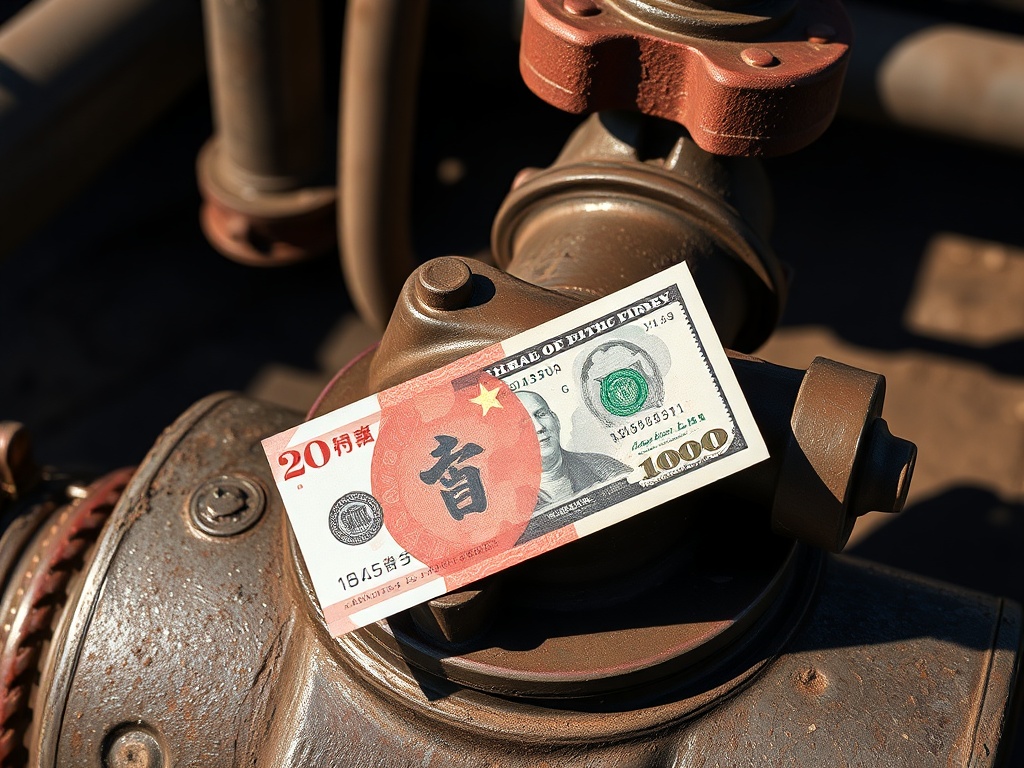
China has been building the infrastructure for this pivot for years. The oil contract in yuan with Saudi Arabia—still marginal in volume—is not an isolated incident. It is the installation of a financial plumbing alternative. The Petro Yuan does not need to displace the dollar in 50% of global trade to be strategically relevant. It merely needs to offer a credible exit for producers who feel the U.S. security umbrella has holes.
The Iranian conflict amplifies this calculation. Every regional actor observing how this conflict unfolds is updating its risk model regarding the reliability of American protection and, by extension, how costly it is to keep reserves tied to a system that can be used as a weapon against them.
The Cost Structure of the Dollar as Imperial Currency
Maintaining monetary hegemony comes with a concrete operational cost that rarely appears in conventional macroeconomic analyses. The United States finances part of that privilege by subsidizing the regional security of oil producers. That subsidy is not free: it is paid in military presence, diplomatic commitments, and the willingness to intervene when supply stability is threatened.
When that willingness becomes ambiguous, the cost of privilege rises for all. Producers demand more guarantees or seek alternatives. Importers diversify their payment mechanisms. Central banks gradually adjust the composition of their reserves. None of these movements occurs abruptly, but their accumulation shifts the slope of the curve.
What we are witnessing in the Iranian oil market—sanctions, alternative export routes, payments in yuan or barter of commodities—is a laboratory to see how far dedollarization can go when incentives are strong enough. Iran is already operating outside the dollar system out of necessity. The strategic question is how many other actors will do so for convenience.
The structural data supporting the dollar remains formidable: over 80% of global oil transactions are denominated in dollars, and the depth of the Treasury bond market has no equivalent. No alternative currency offers the same liquidity, legal predictability, and access to capital markets today. That does not change in a news cycle. But financial systems do not collapse abruptly; they erode at the edges over years before the center gives way.
The Yuan Doesn't Win, but the Dollar Can Lose Ground
The most frequent mistake in this debate is to frame it as a binary competition: either the dollar maintains its position or the yuan displaces it. That logic overlooks the most likely scenario in the medium term: a multipolar energy payments system where no currency has absolute hegemony, but the dollar operates with a geopolitical discount that it previously did not have.
This discount has direct operational consequences for any business or fund exposed to emerging energy-producing markets. Long-term contracts in the energy infrastructure sectors, financing structures for projects in the Gulf or Sub-Saharan Africa, and hedging mechanisms for commodity exports will need to model scenarios where the denominator of the transaction is not automatically the dollar.
Deutsche Bank's hypothesis—that the world saves in dollars because it pays in dollars—remains valid as a description of the current state. What is changing is the solidity of the second part of that equation. If a growing fraction of energy trade begins to settle outside of the dollar system, the incentive to maintain massive dollar reserves weakens proportionately. Not dramatically, but in the marginal adjustments that central banks make each quarter when they rebalance their portfolios.
Dollar hegemony does not solely depend on confidence in the U.S. economy. It depends on confidence that the security system that underpins it will continue functioning. When that confidence fragments—if only partially—the financial architecture that rests upon it needs to be recalibrated.