
The Legislative Brake on Data Centers No One in Silicon Valley Expected
In March 2025, Senator Bernie Sanders and Congresswoman Alexandria Ocasio-Cortez introduced a legislative proposal aimed at prohibiting the construction of new data centers in the United States. This measure did not arrive as a mere warning or exploratory draft: it came as a formal bill, with direct language and a justification that intertwines energy politics, corporate concentration, and technological governance. Sanders bluntly summarized it during the presentation: "We cannot allow a handful of multimillionaire tech oligarchs to make decisions that will reshape our economy, our democracy, and the future of humanity."
For any company that has committed capital to computing infrastructure over the last three years, this is not mere political noise. It is a market signal with measurable consequences.
The Cost Architecture This Law Would Challenge
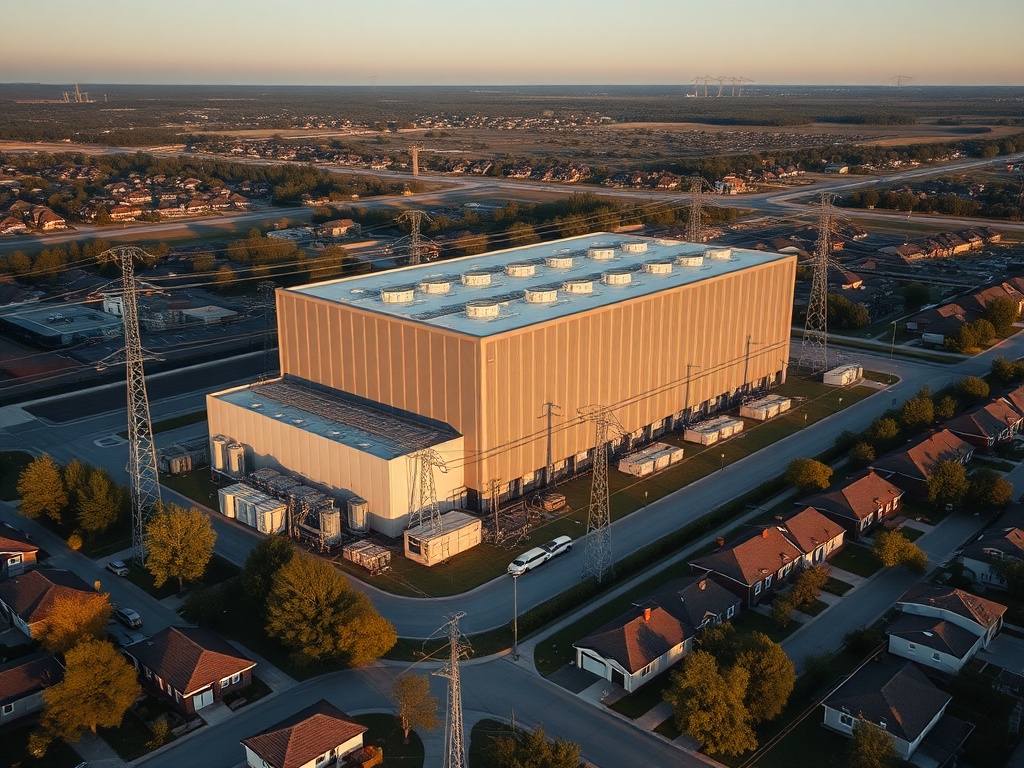
Data centers are essentially a massive bet on fixed costs. Constructing a medium-sized one requires an initial investment between $500 million and $1.5 billion, accompanied by years of power supply contracts, cooling agreements, and connectivity commitments. The financial model relies on that infrastructure operating at high utilization for decades. There is no built-in flexibility: if demand drops, regulations change, or energy costs skyrocket, the asset cannot be easily resized.
The proposal from Sanders and AOC attacks that very point. A ban on new constructions does not eliminate existing data centers, but it freezes the capacity for scaling. For large tech firms, this means their infrastructure expansion plans for artificial intelligence—which in some cases project to double installed capacity by 2027—would be suspended or have to relocate outside U.S. territory. The impact would not be uniform: it would disproportionately affect those players who rely heavily on rapid domestic expansion to maintain their competitive edge in latency and regulatory compliance.
However, there is a less-discussed dimension: the signal this legislative move sends to the debt and private capital markets that finance this infrastructure. Infrastructure funds and specialized data center REITs have secured hundreds of billions of dollars on the premise that demand for computing is virtually limitless and politically untouchable. That premise just received its first serious institutional challenge.
Why No Tech Company Validated This Risk Before Building
The pattern that stands out to me as most revealing from the perspective of investment decision-making in this sector is that large tech firms built their physical infrastructure strategy under an assumption they never formally tested: that indefinite expansion of data centers would encounter technical or economic resistance but never organized political resistance at the federal level.
This is exactly the type of hypothesis that should have been scrutinized before committing capital. Not out of naïveté, but because expansion models that ignore regulatory risk as an active variable ultimately end up generating stranded assets. The coal industry learned this the hard way. The private transportation industry is learning it city by city. Now it’s the digital infrastructure's turn.
The technical argument from companies is well-known: data centers are essential for the digital economy, they generate local employment, and AI requires computing capacity that cannot be produced without them. All of this is descriptively accurate. The problem is that they constructed that narrative inwardly, for their own boards and Wall Street analysts, without proportionately investing in validating their social license to operate. When the electricity consumption of data centers in some states began to exceed that of entire cities, the gap between corporate narrative and citizen experience became unsustainable.
The Sanders and AOC proposal is, in part, a product of that unaddressed gap.
What the Market Will Recalculate if This Law Advances
The likelihood of this proposal becoming federal law in its current form is low. Congress has too complex cross-incentives, and the tech industry boasts considerable lobbying power. But that’s not what matters for medium-term investment decisions.
What matters is the demonstration effect. This proposal legitimizes a regulatory argument that until now lived on the fringes of the debate: that the expansion of digital infrastructure is not inherently a public good and can be subject to restrictions in the public interest. Once that argument has legislative sponsorship in the federal Congress, state and local regulations that limit, tax, or condition the construction of data centers become much more plausible.
For companies with expansion plans on the table, the relevant scenario is not "will this law pass or not." The relevant scenario is "in how many subnational markets will a local version of this argument emerge in the next 18 months?" That number is going to grow. Each local instance has the potential to delay projects, increase permitting costs, or impose energy compensation commitments that were not in the original financial models.
Companies that have already begun to distribute their infrastructure to jurisdictions with stable regulatory frameworks and abundant renewable energy, such as some Nordic regions and areas in the southwestern U.S. with high solar irradiation, will gain a structural advantage that will be appreciated. Those that concentrated capacity in politically volatile markets will bear a risk premium that their valuation models did not capture two years ago.
The Experiment This Crisis Forces Us to Reconsider
There is a product-building lesson that directly applies to how the industry arrived here. When a product or service scales without iterating on its impact on stakeholders who are not the direct customer, it accumulates unaccounted liabilities. In the case of data centers, the direct customer is the tech company that leases capacity. But the neighbor who sees their electricity bill rise, the municipality that forgoes water for cooling, and the worker whose job did not materialize as promised are stakeholders whose willingness to tolerate that model was never measured seriously.
This is not moralism: it is a strategic design failure. A business model that does not incorporate the costs of its own social tolerance ultimately pays for them in another way, whether through regulation, political conflict, or both. The Sanders and AOC proposal is the bill for an expansion process that operated as if those costs did not exist.
Companies that wish to continue investing in digital infrastructure in the coming years will need something their predecessors did not build: empirical evidence, gathered before committing capital, that the communities where they operate consider that agreement legitimate. Not as a public relations exercise but as real input for location, scale, and operational design decisions.
Sustainable business growth does not happen when the financial plan is impeccable on a spreadsheet: it occurs when every assumption of that plan has been subjected to contact with reality before capital is committed and it is too late to adjust.