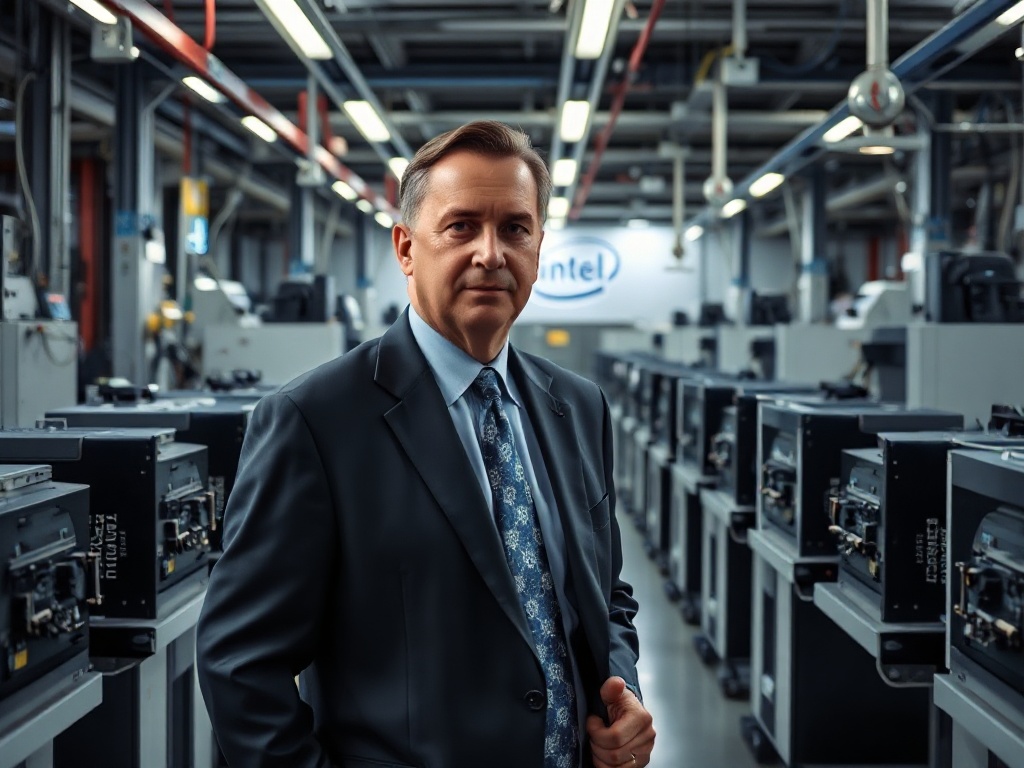

How Lip-Bu Tan Cut Intel in Half and Multiplied Its Value by Five
There is an image that persists in the corporate memory of Silicon Valley: the "Intel Inside" sticker affixed to millions of personal computers as a signal of quality, a kind of tacit guarantee that the machine ran on something solid. For two decades, that sticker was one of the most recognizable brands in the technology world. Then Steve Jobs rejected Intel for manufacturing the iPhone's chips, describing the company as "really slow, like a steamship," and chose ARM instead. That phrase was not merely an insult; it was a diagnosis that Intel took twenty years to take seriously.
What happened next is a story that should make any board of directors uncomfortable: the company not only lost the mobile market, but was also overtaken during the era of artificial intelligence by competitors who built their advantages while Intel continued managing its own inertia. By early 2025, the company was carrying approximately $50 billion in debt and had gone through six chief executive officers since Andy Grove left the role in 1998. The question was no longer whether Intel could compete. It was whether it could survive as an independent company.
The answer, at least for now, has a name: Lip-Bu Tan, who took over as chief executive officer in March 2025 and became the third person to hold that position in just six years.
The Diagnosis Nobody Wanted to Sign
When Tan arrived, Intel did not have a technology problem or a market problem in isolation. It had an organizational problem that had rendered its technological and market problems invisible to those making decisions. The management structure comprised 12 hierarchical layers. In practice, that means that between the person who detects a problem on the production line and the executive with the authority to resolve it, there can be between six and eight human filters, each with its own incentives to soften bad news before it travels upward.
This pattern is not a corporate anomaly. It is the natural result of organizations that grew over decades under conditions of market dominance. When a company wins almost by inertia, internal information systems become optimized to report success, not to detect warning signals. The managers who rise are those who know how to manage upward, not necessarily those with the greatest clarity about what is happening at the operational levels.
Tan cut that structure in half: from 12 layers down to 6. And he established from the very first day a standard that Chief Financial Officer David Zinsner reproduced with precision: "If there is a problem and you tell me about it in time, it is our problem and we have to solve it together. If you have a problem and you do not tell me, it is your problem." That phrase is not opening rhetoric. It is the only lever capable of changing the behavior of a twenty-year-old bureaucracy: making silence more costly than transparency.
What I find significant about that decision is not that it is novel, but that it is uncomfortable to execute. Reducing managerial layers means that people with a certain seniority, informal power, and networks built over years suddenly lose their formal relevance overnight. In an organization of Intel's scale, that generates friction, resistance, and in some cases, departures. The human cost of that reorganization does not appear in press releases. But the alternative would have been to preserve an organizational architecture designed to produce comfort, not competitiveness.
The Capital Structure as a Condition of Possibility
Reorganizing management is pointless if the company cannot finance its next three years. Intel had a balance sheet problem that was, in part, both the cause and the consequence of its strategic difficulties. $50 billion in debt is not an abstract number; it is the permanent pressure that forces a company to prioritize debt service over investment in research and development, which is precisely what a semiconductor company needs to survive in technological cycles of three to four years.
The solution that Tan constructed was a combination of divestments, capital raising, and strategic signaling. Intel sold non-core assets and activated the network of relationships that Tan had built over decades in the semiconductor industry. The result was investments of billions of dollars from Nvidia and SoftBank, along with a high-risk political maneuver: allowing the Trump administration to convert a scheduled grant of $8.9 billion into an equity stake held by the federal government.
That last decision deserves specific attention. Accepting the United States government as a shareholder carries implications that go far beyond the balance sheet. It means that Intel accepts a level of scrutiny, a type of governance, and a series of commitments that no private company accepts willingly. But Zinsner described it with precision: the government's backing generated a "halo effect" with creditors and investors that stabilized the financing structure at a moment when confidence was the company's scarcest asset.
This sequence reveals a mechanism that business restructuring textbooks tend to oversimplify: external capital does not only finance operations. It functions as a viability signal for the rest of the market. The investment by Nvidia in a direct competitor, in particular, communicated something that no investor relations press release can manufacture: that someone with privileged information about the sector believes Intel has a future. That carries a coordination value that is difficult to quantify but that credit analysts read perfectly.
The 500% Rebound and What It Still Does Not Resolve
Intel's stock rose nearly 500% since this recovery process began. That number attracts attention, generates headlines, and reassures shareholders. It may also be the most misleading part of the narrative.
Stacy Rasgon, an analyst at Bernstein, articulated it with the candor that the industry rarely allows itself in public: Intel "got fat, dumb, and lazy, and got their ass kicked." Rasgon also noted that part of the current momentum in the share price responds to a memory demand driven by artificial intelligence infrastructure that has created additional uses for Intel's traditional CPU chips. That allowed the company to move existing inventory at a pace it had not seen in recent memory. In other words: the market did Intel a favor that Intel did not earn on its own.
The problem is that this favor has an expiration date. Cyclical demand from AI infrastructure is not a competitive franchise. It is a temporary window that allows a company to accumulate cash while building its actual position. And Intel's actual position depends on a single technological bet: that its next-generation manufacturing process, designated 14A, stays on schedule and proves to be competitive against what TSMC offers its most demanding customers.
In semiconductors, delays in manufacturing processes are not operational inconveniences. They are market signals that can displace contracts for years. When TSMC consolidated its leadership in advanced manufacturing, it was not because Intel made bad chips. It was because Intel accumulated enough delays for its largest customers to start diversifying suppliers, and that diversification turned into dependency. Apple is the most emblematic case: after excluding Intel from the iPhone, the company also migrated its personal computer chips to ARM architecture. The fact that today there are reports suggesting Apple could return to using Intel as a supplier is, simultaneously, a signal of renewed confidence and a reminder of how much ground was lost.
What Survives When the Bureaucracy Falls
There is a phrase that Tan recovered from Andy Grove, the founder who transformed Intel into the dominant company of its era: "Only the paranoid survive." His predecessors cited it frequently as part of the corporate mythology. Tan adopted it as an operational standard, not as an ornament.
The difference between quoting a maxim and applying it is the distance between a culture that manages its past and one that faces its current situation directly. During Intel's years of decline, Grove's phrase circulated in internal presentations while the company was accumulating layers of management that made productive paranoia impossible. Paranoia requires unfiltered information. It requires that the person who detects the problem can say so without cost. It requires that bad news arrives before it is too late to act on it.
When Tan reduced management levels from 12 to 6 and established that silence is more costly than transparency, he was not implementing a leadership philosophy. He was changing the information incentives within an organization that had learned, over years, to produce comfortable news upward. That change is harder to execute than any financial restructuring, and its effects take longer to become visible. It is also, in all likelihood, the only intervention capable of changing Intel's fortunes over the long term.
A 500% rebound in the share price buys time and credibility. The 14A process, if it stays on schedule, can win back customers. But neither of those two things sustains a company if the organization remains a system designed to protect decision-makers from the consequences of their decisions. That is what Tan attacked first, and that is what will determine whether everything else is enough.