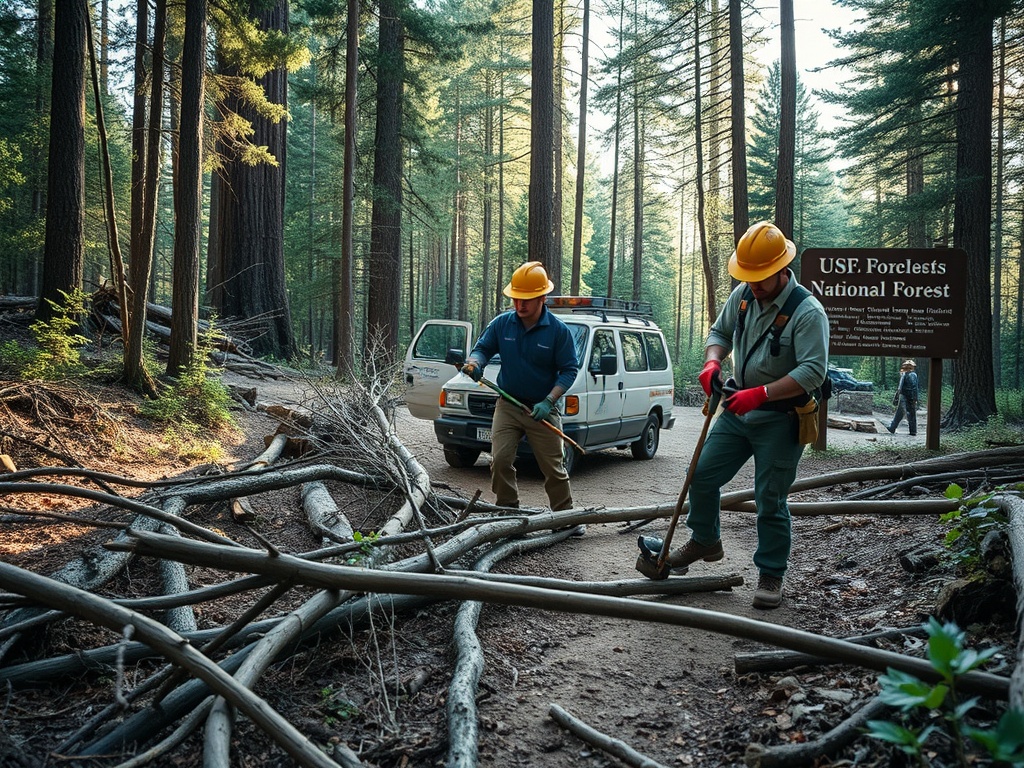

It’s tempting to read the U.S. Forest Service’s new hiring spree as just another administrative story: a public agency re-posting vacancies, candidates applying through USAJOBS, and managers trying to ‘save’ the summer season. But what truly matters—and should unsettle any executive—is the combination of 2,000 seasonal positions announced for summer 2026, in a mere 10-day window (from February 20 to March 3), following a prolonged hiring freeze and mass layoffs that reduced the workforce by approximately 10%. This isn’t a normal talent process; it's a sign of an organization operating with no margin.
As reported by The Spokesman-Review, the organization that manages 193 million acres of national forests and grasslands is scrambling to regain its on-the-ground presence—trails, maintenance, visitor services, data collection—against the clock. Peggie dePasquale, a former Forest Service employee and now director at the Wyoming Wilderness Association, summarized it pragmatically: it would have been “incredibly helpful” to have more time, “and we don’t have it.” The harsh subtext is clear: when operations depend on compressed timelines, leadership is reacting rather than directing.
As an analyst of organizational culture, I’m less interested in the hiring headline and more in what it reveals about institutional capacity, the invisible part that supports public outcomes without needing heroics.
Ten-Day Hiring Is Not Speed; It’s Accumulated Debt
The Forest Service reopened seasonal recruitment roughly a year after a hiring freeze and layoffs linked to cuts by the Department of Government Efficiency (DOGE), which eliminated nearly one-tenth of its staff. The agency is now pushing for massive seasonal hiring for concrete tasks: trail cleaning, campsite and infrastructure maintenance, visitor support, data collection, and stewardship in general.
The problem isn’t those functions; it’s the mechanism. Historically, according to their own reporting, the seasonal cycle was predictable: postings in October, applications in December, and offers about a month later. That pattern was disrupted “for a couple of years” and replaced by late and shortened openings like the current one. In management, predictability is not bureaucracy; it’s risk control. When an organization relies on seasonal talent to execute basics—clean bathrooms, keep access open, have passable trails—the timeline cannot be a detail.
A compressed hiring process does not “filter for the best.” It tends to filter for those who are more available, who already know the system, or who can react quickly to a late announcement. This creates two cultural effects that are seldom measured:
1. Increases inequality of access to opportunities for profiles with fewer networks or less experience in federal procedures.
2. Degrades the quality of matching between person and destination because it forces choices with incomplete information and urgency.
DePasquale and her organization even created resources to help candidates navigate the process. This fact is revealing: when external actors have to “patch” the readability of recruitment, the internal talent system is already in distress.
The Myth of “Rebounding” After Cuts: Rebuilding Is Not Just Reposting Vacancies
The reporting sets a crucial context: in the fall of 2024, the Forest Service announced a shift, halting the traditional seasonal hiring and pushing for “permanent seasonal” roles with more stability. That structure—designed for continuity—was subsequently hit by the layoffs of February 2025, which eliminated many of those recently created positions, according to dePasquale.
Here emerges a classic management pattern: redesigning a structure and then undoing it in the next political or budgetary shift, without a mitigation mechanism. It’s not about judging intentions; it’s about accepting the operational impact. If the continuity of field staff became a structural gamble and was then cut, the organization is left with the worst of both worlds: lacking the promised stability and the previous predictable seasonal cycle.
Additionally, the news details how the courts blocked the layoffs about a month later and the government attempted to rehire. Some returned, while others moved to the private sector or nonprofits, with uncertainty around their stability. That sequence—layoffs, blocks, rehirings—has a cost that rarely shows up in budgets: employer credibility. The people who sustain daily operations quickly learn how fragile the psychological contract is.
In 2025, allied organizations reported visible deterioration on the ground: maintenance, sanitation, basic infrastructure. There were even nonprofits that hired former Forest Service workers to fill gaps in trail projects. When third parties have to absorb essential execution, the institution is outsourcing capacity without designing it as a strategy but rather as a reaction.
The announcement of 2,000 hires is “an important first step,” in dePasquale’s words. It’s also a tacit admission: the system has run out of boots on the ground.
Redesigning the Application Process Is a Positive Gesture, But Doesn’t Replace Governance
Among the changes in this blitz, there is one human-level positive: resumes are now limited to two pages, breaking the federal practice of lengthy histories that try to capture “literally every experience.” This decision reduces friction and makes the system more accessible.
However, it’s crucial to consider this in its real scale. Simplifying the resume is an interface optimization; it doesn’t resolve the underlying question: how is operational capacity governed when the organization depends on thousands of temporary roles and a timeline that, according to the report, is no longer reliable.
The described mechanics—applying via USAJOBS by selecting nearby forests and cities—also reveals another tension: the Forest Service is competing for labor in specific geographies, with living costs, seasonal housing, and logistical limitations that vary drastically. The news does not provide data on compensation or housing, so I cannot infer those. What I can assert is the following: when hiring massively and late, the time available to resolve real onboarding and mobility frictions is reduced. The typical result is early turnover, absenteeism, or positions that remain filled in paper but not on the ground.
At the same time, the head of the Forest Service, Tom Schultz, warned in an internal letter that the year of fire 2025 was turning out to be “extremely challenging.” This phrase matters because it connects two worlds that many organizations separate by organizational chart: recreation and maintenance on one side, fire on the other. In reality, they share a common bottleneck: sufficient, trained, and available personnel.
If, as reported by ProPublica with internal data, there were thousands of firefighter positions vacant in 2025 and a significant portion of those who accepted retirements or deferred resignations had combat credentials (red cards), the system faces a capacity dilemma: replenishing seasonal recreation roles helps visitor experiences, but fire pressure consumes attention, budget, and leadership. Managing that tension is a matter of organizational architecture, not herculean bravery.
The Lesson for C-Level Executives: Maturity Is Measured by Systems, Not Announcements
For corporate leaders, this public story holds immediate private value. It shows how an organization can become trapped between cuts, broken cycles, and operational urgencies, then attempt to rebuild through mass campaigns. In businesses, the equivalent often appears as a “hiring sprint” to save a quarter, a launch, or a seasonal peak. The real cost appears later: burnt-out teams, poor onboarding, and a culture where critical work exists in a permanent state of exception.
Three executive lessons emerge clearly:
1. Capacity planning is not an annual document; it’s a calendar discipline. When the cycle compresses, the risk shifts to the end-user: unmaintained trails, degraded facilities, slower response times. In private business, that shift manifests as churn, returns, incidents, or loss of reputation.
2. Employer credibility is an operational asset. Laying off and rehiring, freezing and reopening, promises one thing and delivers another. Even if external reasons exist, the system must be designed to cushion the blow, because the labor market learns faster than the executive committee.
3. Frontline execution is strategy. The news talks about bathrooms, trails, campsites, and public access. It’s easy to underestimate that “basic work” until it disappears. In any organization, the fundamentals sustain customer trust and social license. Serious leadership protects that layer like it’s critical infrastructure because it is.
The Forest Service is trying to rebuild its ground presence with 2,000 seasonal hires. That number is significant, but the decisive indicator is another: whether the institution can recover a predictable, readable, and stable system of field talent rather than relying on late pushes that turn operations into a state of emergency.
Executive maturity is recognized when leadership builds a structure so resilient, horizontal, and autonomous that the organization can move into the future without ever relying on the ego or indispensable presence of its creator.