
Dior Bets on Training Leaders Who Understand What Their Own Products Are Made Of
There is a structural problem that few luxury brands have been willing to name clearly: for decades, sustainability was managed by a small, specialized, and in practice peripheral team. The rest of the organization — designers, buyers, logistics teams, retail managers — operated with a different vocabulary, different metrics, and a different hierarchy of urgencies. The result was not bad faith. It was an organizational architecture that produced environmental commitments that never quite managed to land in practice.
The decision by Christian Dior Couture to launch a formal sustainable leadership training program with the Institut Français de la Mode targets that problem directly. It is not a communications initiative. It is, at least in its design, an attempt to change who within the organization has the real capacity to make decisions grounded in environmental criteria.
The Gap That No Sustainability Report Publishes
Dior has publicly committed to having 100 percent of its strategic raw materials certified by 2026, up from 81 percent in 2024. It has also committed to training all of its employees on environmental topics within that same timeframe. These are concrete commitments, with dates and metrics — the kind of objective that, if unmet, remains on the public record.
The problem with those commitments is not in their ambition. It lies in the human architecture that must execute them.
Certifying raw materials is not an administrative act. It requires that purchasing teams understand what each standard actually certifies, that designers are able to work with certified alternatives without feeling they are sacrificing quality or creative freedom, and that financial managers understand why paying a premium for certain materials is different from simply paying more for the same thing. If those conversations do not happen through a shared language, certification stays in the hands of the sustainability team and the rest of the organization views it as an external constraint, not as part of their own work.
Clément Lefevre, Director of Sustainability at Christian Dior Couture, described the program as "an engine of action, enabling teams to translate the maison's vision into concrete, innovative, and meaningful initiatives." The phrasing is not trivial. Lefevre does not speak of awareness-raising or culture. He speaks of translation: of converting a strategic vision into distributed operational capacity.
That is, technically, the hardest thing to produce within a large organization.
What IFM Brings That an Internal Course Cannot
The Institut Français de la Mode is not a conventional training provider. Since 2019 it has operated the IFM-Kering Sustainability Chair, led by Andrée-Anne Lemieux, with an explicit mandate to integrate environmental and social responsibility into the creative and managerial processes of the fashion and luxury industry. The fact that Dior — a direct competitor of Kering in multiple segments — chose the same academic institution to develop its leadership program says something about the position IFM has built: it is perceived as a neutral node with sufficient credibility to work with groups that are in commercial tension with one another.
That neutrality has concrete economic value. When training comes from inside the company, it inevitably carries the weight of internal interests and internal narratives. A program developed with a reference academic institution arrives with a different epistemic authority, particularly for technical and creative profiles who are skeptical of messages they perceive as corporate propaganda.
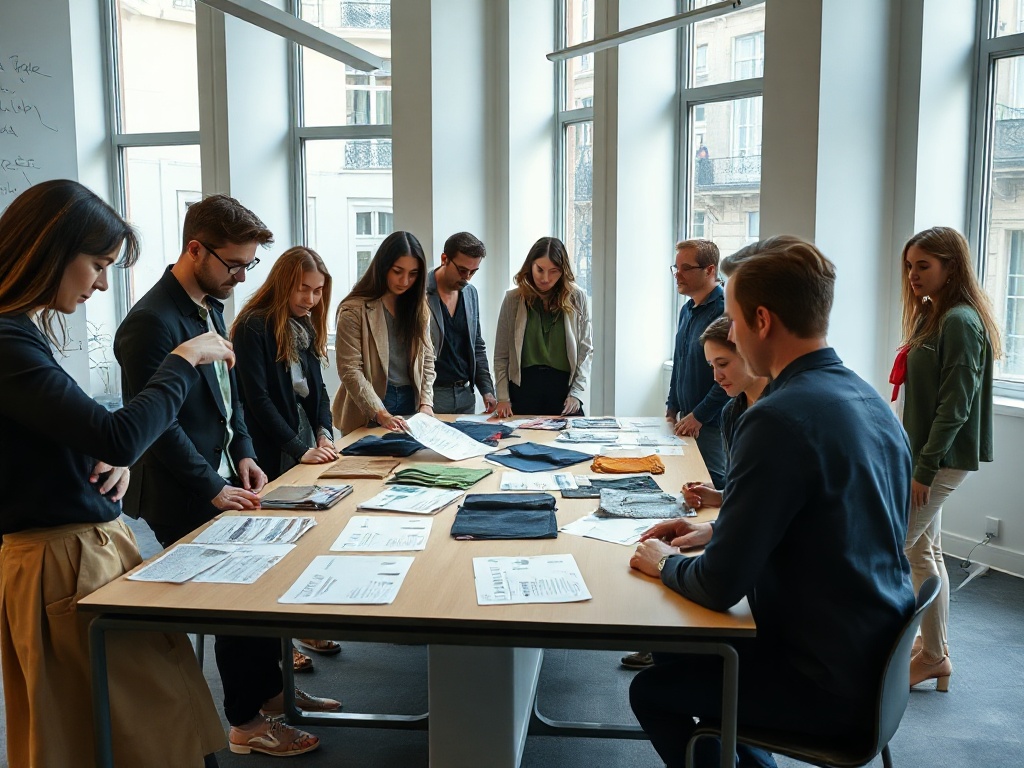
The program for the first cohort of 23 employees drawn from more than 15 departments — including design, merchandising, logistics, finance, legal, and supply chain — is structured around four modules covering regulation, responsible sourcing, traceability, biodiversity, ecodesign, circularity, climate, and sustainable performance. Participants will also receive coaching to develop projects intended to be implemented within the company itself.
That last detail is the most structurally relevant one. This is not a passive certification program. Each participant must produce an applied project. That transforms the training into a mechanism for generating real internal capacity, not merely declarative knowledge.
The Gap Between Institutional Discourse and Organizational Architecture
Dior operates within LVMH, whose environmental plan Life 360 sets group-level objectives on climate, creative circularity, traceability, and biodiversity through 2030. The problem with large group-level roadmaps is their tendency to remain at the highest levels of the hierarchy. The maisons receive the objectives, but the mechanics of how those objectives translate into day-to-day decisions within product or purchasing teams are left unspecified.
From this perspective, the Dior-IFM program functions as a top-down translation mechanism: it takes group-level commitments and converts them into distributed competencies. If it works, the impact will not be visible in the next ESG report. It will be visible years later, when regulatory pressure in the European Union — due diligence, ecodesign, green claims — intensifies and Dior has purchasing and design organizations capable of responding with their own informed judgment, rather than turning to the sustainability team for guidance.
But there is a fragility in the design that deserves attention. A first cohort of 23 people in an organization the size of Dior is a small number. The question is not whether 23 well-trained individuals can generate useful projects — they probably can. The question is whether that model scales at the speed needed to meet the commitment to train all employees before 2026. The time between a pilot cohort and broad organizational coverage tends to be longer than institutional calendars anticipate, especially when training requires individual project coaching.
There is no public data on the planned pace of expansion, the number of cohorts scheduled, or the percentage of the workforce the program currently covers. That opacity does not invalidate the effort, but it does limit the ability to assess whether the ambition of the program and the ambition of the environmental commitments are truly aligned in terms of timing and scale.
When Training Becomes Infrastructure Rather Than an Event
The model emerging from the Dior-IFM partnership has a logic worth isolating, because its success or failure does not depend on the content of the program but on a deeper organizational decision: whether the company treats this program as a training event or as the first component of a capacity infrastructure.
In the first scenario, the pilot cohort produces interesting projects, several of which are implemented, and the program fulfills its function as an institutional signal directed outward — toward investors, consumers, regulators — without materially changing how decisions are made in supply chains or in product meetings. That scenario is not a total failure, but it does not justify the level of expectation that the "Dream in Green" framework generates.
In the second scenario, the pilot cohort produces learning about what works pedagogically with the profiles Dior needs to train, that learning is incorporated into a scalable architecture — combining the high-intensity program with more accessible e-learning modules — and the company measures not only how many people completed the training, but how product and sourcing decisions changed within the teams that participated.
The difference between the two scenarios does not lie in the quality of the program with IFM. It lies in the willingness of Dior's leadership to accept that sustainability training is not a reputational cost but an investment in the reduction of operational and regulatory risk. That distinction determines how many resources are allocated to scaling the program and what metrics are used to evaluate its real impact.
What this move by Dior reveals, beyond its own specific case, is that the luxury industry has reached an inflection point at which environmental commitments can no longer be sustained exclusively by well-intentioned sustainability teams. The volume of regulatory requirements accumulating across Europe, the technical complexity of natural raw material supply chains, and the speed at which traceability standards are being tightened all demand that analytical capacity in sustainability be distributed across the real decision-making nodes of the organization. Brands that build that capacity before regulatory pressure becomes unavoidable will face fewer frictions in the transition. Those that wait will be paying external consultancies to respond to audits that their own staff should be able to manage. Dior, at least in its design, has chosen the first path.