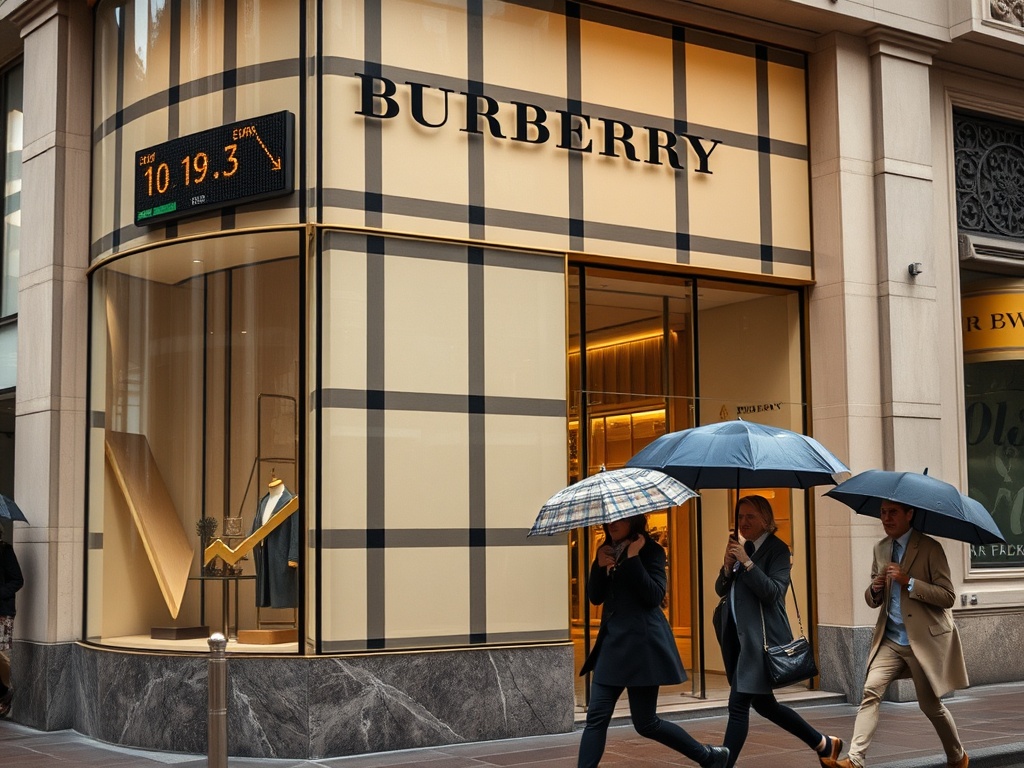

Burberry Made Money Again, and the Market Gave It a Thumbs Down
There is a type of financial result that confuses more than a loss: the one that confirms something improved, but not enough to matter. Burberry published on May 14, 2026 its annual results through March 28 of that year, and the reading is exactly that. The company swung from a pre-tax loss of £66 million to a profit of £49 million. Comparable retail sales, which had fallen 12% the prior year, this time grew 2%. Gross profit rose 7% to £1.643 billion, even as total revenues slipped slightly from £2.46 billion to £2.42 billion. Chief Executive Officer Joshua Schulman spoke of a "significant inflection point." Shares fell close to 6% on the day of the announcement.
That is not a contradiction. It is a signal worth reading carefully.
The market was not ignoring the data. It was reading the data with a different question than the one the company posed. Burberry said: look at how much we improved. Investors responded: show us how much you can grow. And therein lies the real tension running through this case.
What the Numbers Show When Read in Order
The gross margin improved while revenues declined. That is precisely what happens when a company reduces its exposure to discounts, outlets, and low-price wholesale channels in order to defend its positioning. Burberry has spent years trying to detach itself from the brand profile that mixes a £2,000 trench coat with the checked pattern reproduced across all manner of mid-price accessories. The "brand elevation" strategy has a very specific financial mechanic: during the transition phase, revenues compress because less volume is sold, but at higher prices and with fewer discounts. If the process works, the margin improves before revenues do.
That is exactly what is happening. £1.643 billion in gross profit on £2.42 billion in revenues implies a gross margin of close to 68%, which for a luxury brand in the middle of a restructuring is a signal that the channel clean-up is working. Outerwear and scarves grew at a double-digit rate in the second half. E-commerce rose by percentages described as "high teens" in the company's release. The fourth quarter delivered comparable growth of 5%, exceeding market expectations of 4.6%, with 10% growth in Greater China and another 10% in the Americas.
But free cash flow, although it improved from £65 million to £141 million, still reflects a company that has not recovered the capacity to reinvest with meaningful headroom. And the adjusted operating profit of £160 million — compared to £26 million the previous year — looks imposing in relative terms, but represents barely a 6.6% operating margin on sales. For a brand aspiring to position itself at the very top of European luxury, that number sits several rungs below industry standards.
This is where the narrative of the "inflection" begins to encounter its limits.
The Gap Between Narrative and Structure
Burberry is not in bad shape. That is important to say without ambiguity. The company stabilized its model, recovered profitability, and demonstrated that the bet on margins over volume has technical logic. But there is a difference between having halted the deterioration and having built the foundation for sustainable growth. And that difference is precisely what divides the analysts who read this result as a success from the institutional investors who read it as a promise without sufficient backing.
The note from Jefferies analysts cited in coverage of the case describes the close of fiscal year 2025/26 as "well anticipated," and points out that the result beat the market consensus by 4% in terms of adjusted EBIT, but fell short of "the more optimistic hopes on the buy side" — that is, the institutional funds with long positions. That language matters. It means the market had already priced in a large portion of the recovery, and wanted to see more. The question around the guidance for fiscal year 2027 — which includes revenue growth orientation and margin expansion — is being received with caution because it is wrapped in warnings about the geopolitical and macroeconomic environment, while the market consensus expects 290 basis points of improvement in EBIT.
Burberry also announced that board chairman Gerry Murphy is retiring after eight years in the role, and that senior independent director William Jackson will take his place. That governance change at the exact moment of a supposed strategic inflection is not without consequence. It could be the orderly transition of a cycle that has completed its function, or it could open a phase of greater tension over the direction to take. Investors have no way of knowing yet which of those two things it will be.
The combination of a result that beats the consensus but not institutional optimism, together with a change in board leadership and guidance that acknowledges macroeconomic headwinds, produces a mix of signals that the market chose to read with caution. Falling 6% in the session on the day of a result that technically beat estimates is the way in which the market price communicates: the margin of positive surprise is exhausted, and what comes next depends on execution, not narrative.
The Model That Has Not Yet Been Tested Under Real Pressure
What Burberry is building makes strategic sense on paper. Reducing discounts, concentrating the proposition on higher-value categories, strengthening the direct-to-consumer channel, and disciplining wholesale are exactly the moves that distinguish a solid luxury brand from an aspirational brand with an elevated price tag. The problem is that this model has not yet been tested under the conditions that truly matter.
The 2% growth in comparable sales was achieved with tailwinds in the markets Burberry depended on most: Greater China contributed 10% in the fourth quarter. But Chinese luxury demand has shown high volatility in recent years. A cooling of that market — whether due to domestic macroeconomic factors or international trade tensions — can easily erase accumulated progress. The guidance for the first half of the coming year anticipates mid-single-digit wholesale growth, which suggests that part of the revenue momentum will come from that channel, not solely from the recovery in directly operated stores.
The annualized cost savings of £100 million the company expects to complete by the end of fiscal year 2027 are relevant, but also temporary as a margin lever. Once that efficiency is captured, the next move in profitability has to come from revenue growth or an additional structural improvement in product mix. Neither of those two levers is guaranteed in the current environment, where upper-mid luxury faces competition from above — from brands with greater pricing power such as Hermès or Brunello Cucinelli — and from below, with premium brands offering similar aesthetics at lower cost.
The countervailing headwind that Burberry itself mentions in its guidance — a foreign exchange impact of £10 million in both revenues and adjusted operating profit — is small in absolute terms, but illustrates a structural vulnerability that does not go away: a company with global revenues reported in British pounds is constantly exposed to variables it does not control.
The Inflection That Must Still Earn Its Own Name
Burberry demonstrated that it can stop a decline, recover gross margins, and return to profitability after a year of losses. That is not nothing. It is, in fact, the result of concrete operational decisions made under pressure and with deliberately absorbed short-term costs.
What it has not yet demonstrated is that the reformed model can generate consistent growth with operating margins that justify a European luxury valuation. A 6.6% adjusted operating margin on sales is the starting point of a recovery, not the destination of a front-line luxury brand. And the market — with all the dispassion of pricing mechanisms — has already calculated that the easy part of the recovery is already in the price.
Joshua Schulman is right that something changed at Burberry during this fiscal year. But calling it a "significant inflection point" is anticipating a conclusion that the market is not prepared to validate with a premium in the share price until it sees, at minimum, two or three more quarters of sustained comparable growth accompanied by real operating margin expansion. The company has the structure to attempt it. What is missing is time, and the execution that converts that improved skeleton into something that generates more cash than it consumes to grow.