
AngloGold Ashanti Generated $2.9 Billion in Free Cash Flow and Is Now Betting Everything on Nevada
Gold broke 53 price records during 2025. AngloGold Ashanti took advantage of every single one — and then went even further.
At its Annual General Meeting held on May 5, 2026, the company presented figures that few mining companies have ever been able to show in their history: $2.9 billion in free cash flow, an adjusted EBITDA of $6.3 billion, and dividends of $1.8 billion, equivalent to 62% of the cash generated. The balance sheet closed 2025 with an adjusted net cash position of $879 million, with no net debt. For an industry that spent decades financing its growth through leverage and promises, this is an anomaly that deserves close examination.
But the meeting was not simply a celebration of metrics. There was a fatality at Obuasi. There is a major bet in Nevada that has yet to produce a single gram. And there are shareholder questions about the gender pay gap, biodiversity, and emissions that can no longer be answered with statements of intent. What happened in that room says more about the state of the global gold sector than any consensus market report.
When Cost Discipline Becomes a Structural Advantage
The figure that interests me most is not the record-breaking cash flow. It is this one: while AngloGold Ashanti's peers increased their unit costs by an average of 24% in real terms since 2021, the company kept its own increase to just 4% through its Total Asset Potential program. That is not ordinary operational efficiency. It is a productivity gap that, in a business where the commodity price is set by the global market, translates directly into margin.
The incorporation of Sukari in its first full year under AngloGold ownership is the most concrete proof of this. The Egyptian mine produced 500,000 ounces at a total cash cost of $783 per ounce — the lowest in the portfolio — and generated "almost a third of the net cost of the Centamin acquisition" in a single year. If that figure holds up to scrutiny, the company effectively paid back the acquisition within three years of operation, not ten. That does not happen by accident: it happens when post-acquisition integration prioritises the capture of efficiency over the preservation of inherited structures.
Total production reached 3.1 million ounces, a 16% year-on-year increase. Obuasi contributed 266,000 ounces as it ramps toward full capacity. Geita and Cuiabá offset localised disruptions by improving grade and recovery. What CEO Alberto Calderon described as the "fifth consecutive year of meeting production guidance" is not a minor detail in a sector where delays and cost overruns are the historical norm, not the exception.
The resulting financial architecture is that of a company that transformed a high-fixed-capital cyclical business into something more closely resembling a predictable cash generator. It did not eliminate gold price risk, but it did reduce its exposure to the two factors that have historically destroyed value in mining: operational cost overruns and rigid debt structures. Closing 2025 with a positive net cash position — after paying out 62% of free cash flow in dividends and financing expansions — marks a standing that few competitors are in a position to replicate today.
Nevada as a Generational Bet, Not a Project
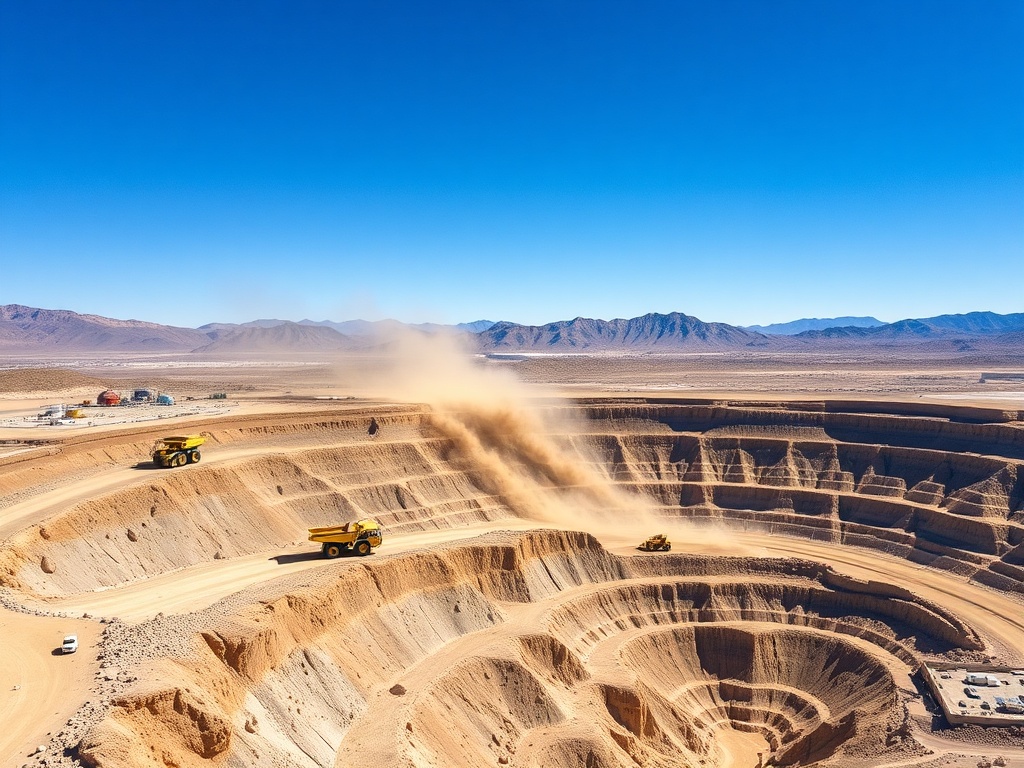
The declaration of an inaugural mineral reserve of 4.9 million ounces at the Arthur Gold Project in Nevada is the most far-reaching strategic move the meeting revealed. This is not a maintenance reserve. It is the cornerstone of what the company explicitly describes as its long-term strategy to establish a low-cost production base in the United States.
The completed pre-feasibility study supports an initial mine life of nine years, with estimated annual production of 500,000 ounces and an all-in sustaining cost of $954 per ounce. At current gold prices — which at the time of the meeting exceeded $3,300 per ounce according to market futures — that margin per ounce is considerable. The acquisition of Augusta Gold, completed in October 2026, expanded the development options within the district.
What is analytically relevant is not only the size of the project but the geopolitical logic behind it. Gold mining production in West Africa and East Africa, where AngloGold holds substantial assets, faces risks ranging from electoral disruptions — such as those recorded in Tanzania around local elections — to illegal mining pressures that intensify as the metal price rises. The board chairman himself, Jochen Tilk, noted that high gold prices increase the incentives for artisanal mining and illegal incursions onto concession properties.
Nevada offers a radically different operational risk profile: a stable jurisdiction, developed infrastructure, a predictable regulatory regime — though with its own permitting timelines. The company is not diversifying out of market fashion. It is building a second productive base in a jurisdiction that better protects value against political stress scenarios in its current operating markets.
The addition of more than 9 million ounces of new mineral reserve during 2025 — approximately three times what was depleted — marked the ninth consecutive year of reserve growth before depletion. That is asset replenishment at a rate that few companies in the sector sustain. It means that the future production engine does not depend exclusively on Nevada: there is a portfolio in development that provides support regardless of how long the North American project takes to reach production.
The Obuasi Fatality and What It Reveals About Real Governance
No analysis of this meeting would be honest if it omitted what happened twenty days before the gathering. A worker named Nicholas Owuku, 53 years old and an employee of the contractor Mining Tools Ghana, died at the Obuasi mine as an apparent result of "the release of material from one of the underground ore passes." The CEO described the details of the incident to shareholders and committed to ongoing support for the family, while a multidisciplinary team investigates the root causes.
The tension between the lowest safety metric ever recorded — 0.97 injuries per million hours worked across managed operations — and a recent fatality is not a contradiction that can be resolved through narrative framing. It is the structural tension of any large-scale industrial operation: statistical averages and individual tragedies coexist, and real governance is measured by the speed and depth of response to individual cases, not by aggregate averages.
What I observe in the structure of the meeting is something that institutional shareholders increasingly value: the integration of sustainability questions within the formal flow of the meeting itself, not as a separate session or an appendix. The questions posed by Zizipho Mabuya of Aeon Investments Management — covering the gender pay gap by geographic location, biodiversity and rehabilitation metrics, the challenges facing emissions targets following the Centamin acquisition, and liability timelines in South Africa — received concrete answers at the podium, with named commitments attached.
On emissions: Calderon reiterated the target of a 30% reduction in Scope 1 and 2 emissions by 2030 and cited specific projects currently underway — solar expansion at Sukari, a grid connection at Geita already implemented using hydroelectric power, solar projects at Siguiri, and what he described as "the largest off-grid renewable hybrid project in the Australian mining sector" commissioned at Tropicana during 2025. The explicit acknowledgement that the Centamin acquisition complicated the path toward that target — rather than downplaying it — is the kind of communication that builds credibility with long-term investors far more effectively than any carbon neutrality declaration that lacks operational backing.
On silicosis liabilities in South Africa: the board confirmed that the responsibilities associated with the divested South African portfolio rest largely with the new owners, with one explicit exception: AngloGold Ashanti "will honour its obligations" arising from the silicosis class action suit through a previously agreed payment mechanism. This is not a generic promise. It is a contractual obligation publicly acknowledged before shareholders, which in governance terms carries a different weight from mere declared intent.
The Gold Market Does Not Forgive Short-Term Myopia
What AngloGold Ashanti is building has a logic that reaches beyond the current price cycle. Gold closed 2025 with 53 all-time records because central banks bought at a rate without recent precedent, geopolitical uncertainty increased demand for safe-haven assets, and global mining production remained relatively flat — around 3,000 tonnes per year — while institutional and retail demand accelerated.
That creates a cash generation window that companies with stronger cost structures exploit in a disproportionately advantageous way. But the market knows that windows close. What separates companies that create generational value from those that simply ride the bull cycle is what they do with that cash while the price is still favourable.
The decision by AngloGold Ashanti to distribute 62% of free cash flow in dividends while maintaining a positive net cash position and funding future reserves responds to a real capital markets pressure: gold mining investors learned, after two decades of value destruction through overinvestment in bull cycles, that they prefer cash today over the promise of future production that frequently arrives late, over budget, or simply never arrives at all. The company is responding to that market-learned lesson, not ignoring it.
Nevada represents the bet that, when that cycle eventually moderates, there will be a low-cost productive base in a premium jurisdiction ready to sustain margins. It is not a guarantee. Mining projects of that scale have a long history of regulatory delays and construction costs exceeding pre-feasibility estimates. But the logic of the bet is sound: genuine jurisdictional diversification, a competitive cost profile, and a reserve portfolio that does not depend on a single asset to justify the valuation.
What shareholders who hold a position in AngloGold Ashanti are signing up for is not generic exposure to the gold price. It is a specific thesis: that a mining company with proven cost discipline, a clean balance sheet, growing reserves, and expansion in a low-risk jurisdiction can deliver returns that outperform the cycle. The May 2026 meeting offered concrete evidence in support of that thesis. The execution of the Arthur Gold project in Nevada will determine whether that evidence holds.